
'/%3E%3C/svg%3E)


How Many Veneers Do I Need? 8, 10, 16 or 20?

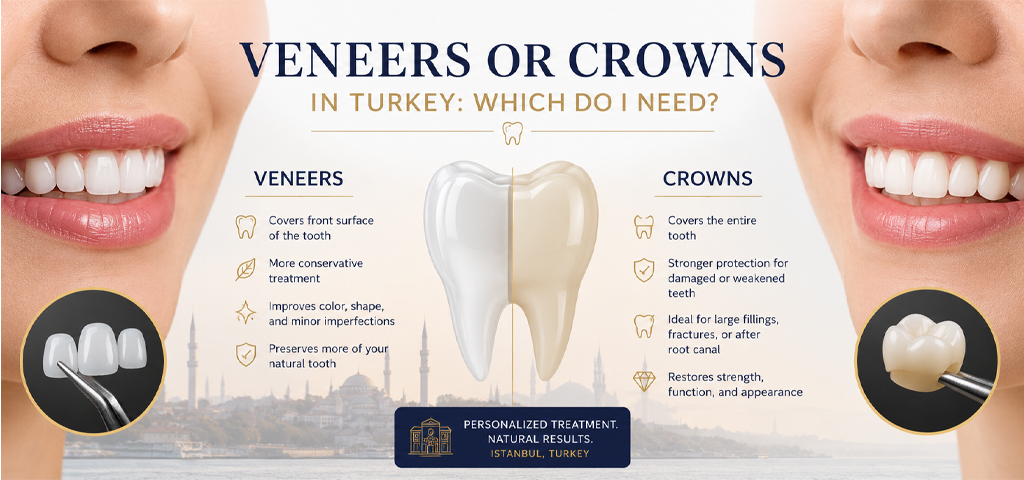
Veneers or Crowns in Turkey: Which Do I Need?
10 August 2026
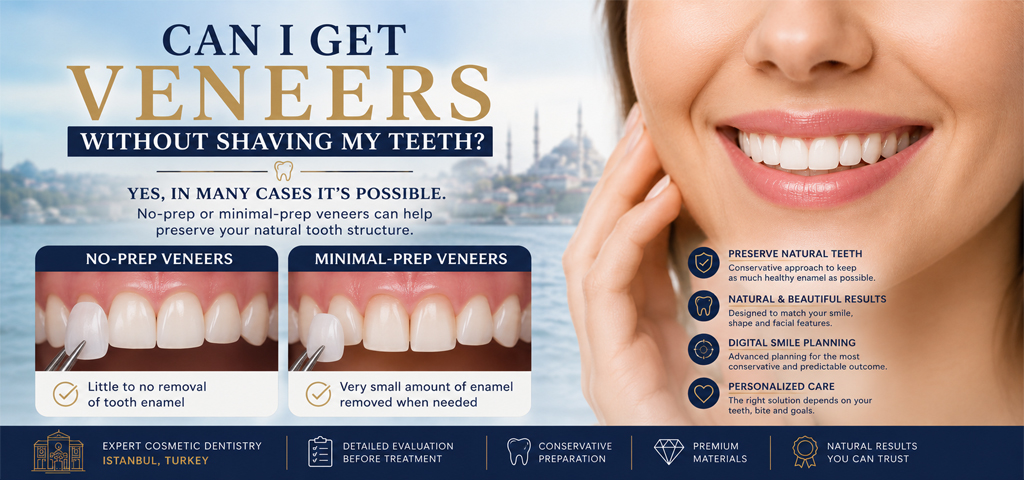
Can I Get Veneers Without Shaving My Teeth?
10 August 2026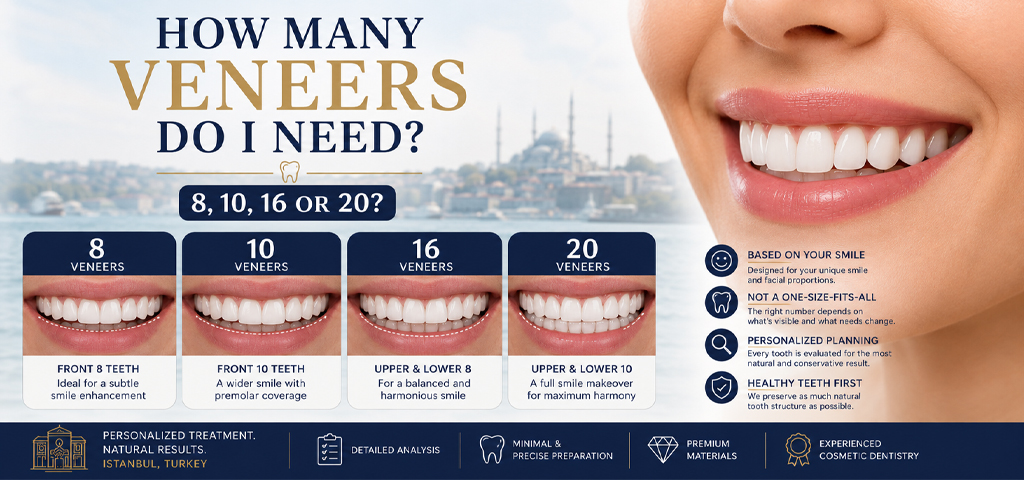
The number of veneers you need depends primarily on how many teeth are visible when you smile, the condition and colour of your natural teeth, your smile width and what you want to change. There is no standard number of veneers that produces the best result for every patient.
Some patients may achieve a balanced smile with 6 or 8 veneers on the upper teeth, while others may need 10 or more to avoid a visible difference between treated and untreated teeth. Treating 16 or 20 teeth usually means including both the upper and lower arches, but this is not automatically necessary for a complete smile makeover.
The goal should not be to choose the highest number of veneers or to fit into a predetermined package. A personalised treatment plan should identify which teeth actually need treatment, which natural teeth can remain untouched and how the treated and untreated teeth will look together when you smile, speak and laugh.
What Determines How Many Veneers You Need?
Your smile line is one of the most important factors. Some people show only their front six or eight upper teeth when smiling, while people with a wider smile may expose 10 or even 12 teeth. If untreated teeth are clearly visible beside veneers, differences in colour, shape or brightness can sometimes make the transition noticeable.
Natural tooth colour also matters. If you want significantly lighter veneers but the teeth immediately beside them will remain untreated, achieving a seamless transition may be more difficult. In some cases, whitening the natural teeth before selecting the final veneer shade can help create a more harmonious result without increasing the number of veneers unnecessarily.
The condition of each tooth must also be assessed individually. A visible tooth does not automatically need a veneer simply because neighbouring teeth are being treated. Some teeth may already have an appropriate shape and position, while others may have fillings, previous restorations, wear or structural problems that require a different approach.
Your facial proportions, lip movement, tooth position, gum levels and bite also contribute to treatment planning. This is why the number of veneers should ideally be determined after analysing the entire smile rather than simply counting the front teeth.
Are 8 Veneers Enough for a Smile Makeover?
Eight veneers can be enough for many patients, particularly when the main aesthetic concerns are limited to the upper front teeth and approximately eight teeth are visible during a full smile. In these cases, treating the upper incisors, canines and selected premolars may create a balanced result without extending treatment to teeth that do not need to be changed.
However, the number should not be chosen before evaluating the smile. A patient with a wider smile may show untreated teeth behind the eighth veneer. If the veneers are noticeably lighter or have different proportions from the natural teeth beside them, this transition may become visible when smiling or laughing.
Eight veneers may be particularly suitable when the natural teeth beside the treatment area already have a compatible colour and shape. Whitening may also be considered before veneer treatment when improving the colour of untreated teeth could help create a smoother transition.
The key question is therefore not whether eight veneers are generally enough, but whether eight veneers will cover the aesthetic zone that is visible in your individual smile.
When Are 10 Veneers a Better Choice?
Ten upper veneers may be considered for patients with a wider smile who display their premolars clearly. Extending the treatment from eight to ten teeth can sometimes create a more continuous transition across the smile, particularly when a significant change in tooth colour, size or proportion is planned.
This does not mean that ten veneers automatically create a better smile than eight. If the ninth and tenth teeth are barely visible or already blend naturally with the planned restorations, treating them may provide little aesthetic benefit. Conversely, if they are clearly visible and significantly darker or differently shaped, leaving them untreated may affect the overall result.
Smile photographs taken from different angles can be useful when making this decision. A straight frontal photograph alone may not show everything that becomes visible during a broad smile. Evaluating the smile from the front and sides, as well as observing natural lip movement, provides a better understanding of where the visible aesthetic zone ends.
The final number should therefore follow the patient’s smile anatomy rather than a standard treatment package.
Why Do Some Patients Get 16 Veneers?
A treatment plan involving 16 veneers often means restoring eight upper and eight lower teeth, although the exact distribution can vary. This may be considered when both the upper and lower teeth are prominently visible and there are aesthetic concerns affecting both arches.
For example, a patient may have significant discolouration, wear, irregular shapes or existing restorations involving both upper and lower front teeth. If the lower teeth are clearly visible while speaking or smiling, treating only the upper teeth may not address the patient’s overall aesthetic concerns.
However, lower veneers should not automatically be added simply to increase the number of treated teeth. Lower front teeth experience different functional forces and often have less available space. The bite, tooth position and amount of enamel must therefore be assessed carefully before veneers are considered.
Many patients who want a smile makeover do not need veneers on their lower teeth at all. If the lower teeth are healthy and their appearance does not interfere with the desired result, keeping them untreated may be the more conservative approach.
Do I Really Need 20 Veneers?
Twenty veneers usually involve extensive treatment across both the upper and lower arches, commonly around ten teeth in each arch. Some patients may genuinely benefit from this approach, but twenty veneers should not be considered a standard requirement for achieving a complete or attractive smile.
A larger number may be appropriate when both arches are highly visible and multiple teeth have significant aesthetic concerns that cannot be addressed adequately with more conservative treatments. Even then, every tooth should be evaluated individually to determine whether a veneer is appropriate.
If your lower teeth are healthy, minimally visible and aesthetically acceptable, there may be no reason to veneer them simply because a 20-tooth smile makeover has been proposed. Similarly, treating ten upper teeth when only eight contribute meaningfully to the visible smile may not always provide additional benefit.
The number of veneers should therefore be a result of treatment planning, not the starting point. The objective is to treat enough teeth to create a harmonious result while avoiding unnecessary treatment of healthy teeth.
Upper Teeth Only or Upper and Lower Veneers?
Many smile makeovers focus primarily on the upper teeth because they are usually more visible when smiling. If the lower teeth are healthy, have an acceptable colour and are not prominently displayed, there may be no aesthetic reason to place veneers on them.
Upper and lower veneers may be considered when both arches are clearly visible or when the lower teeth also have concerns such as significant discolouration, wear, irregular shape or existing restorations. The decision should be based on what is actually visible and what needs improvement rather than on creating the same number of restorations in both arches.
The relationship between the upper and lower teeth also affects the decision. Veneers change the contours and surfaces of teeth, so the bite must be evaluated carefully when treatment involves both arches. This is particularly important for patients who grind or clench their teeth or already have significant tooth wear.
A complete smile makeover does not necessarily mean treating every visible tooth. In some cases, upper veneers combined with whitening or another conservative treatment for the lower teeth may provide a balanced result while preserving more natural tooth structure.
Can I Have Just 4 or 6 Veneers?
Yes, some patients may achieve their desired improvement with only four or six veneers. This is most likely when the aesthetic concern is concentrated around the front teeth and the neighbouring natural teeth already have a compatible colour, shape and position.
For example, four veneers may sometimes be considered when only the central and lateral incisors require changes in shape or proportion. Six veneers can extend the treatment to the canine teeth and may provide a broader aesthetic change while still limiting treatment to the front of the smile.
The challenge with smaller numbers is creating a natural transition between veneers and untreated teeth. If the veneers are significantly lighter, longer or differently shaped, the contrast may become visible. This is why selecting four or six veneers solely to reduce treatment may not always produce the most harmonious result.
On the other hand, increasing the number simply to create a uniform set is not necessarily better. The appropriate number is the smallest treatment area that can reasonably achieve the intended result without creating an obvious transition.
Does a Wider Smile Mean I Need More Veneers?
A wider smile can increase the number of teeth that need to be considered, but it does not automatically mean that all visible teeth require veneers. Some people display eight upper teeth when smiling, while others show ten, twelve or more extending toward the premolars.
The important factor is how the untreated teeth will relate to the veneers. If the teeth at the sides of the smile already have a suitable colour and proportion, they may blend naturally without treatment. If they are noticeably darker, smaller, rotated or differently shaped, the transition may be more apparent.
This is why smile width should be assessed during natural expressions rather than from a single posed photograph. Photographs and videos of the patient smiling and speaking can help show which teeth are consistently visible and how far the aesthetic zone extends.
Does the Shade I Choose Affect the Number of Veneers?
Yes. The greater the planned colour change, the more important the transition between treated and untreated teeth becomes. Very light veneers placed only on a small number of front teeth may contrast with darker natural teeth visible toward the sides of the smile.
This does not necessarily mean that more veneers are required. Professional whitening of untreated teeth may sometimes reduce the colour difference and allow a more conservative treatment plan. The feasibility of this approach depends on the natural tooth colour, existing restorations and the shade the patient hopes to achieve.
Shade selection should therefore be considered together with the number of veneers rather than as a separate decision. The objective is not simply to choose a particular shade from a chart but to create a colour that works with the patient’s natural teeth, skin tone, facial characteristics and overall smile.
For patients seeking a natural-looking result, subtle variations in translucency and surface characteristics can also be important. Natural teeth are not completely uniform, so creating an attractive smile does not necessarily require every visible tooth to have exactly the same appearance.
Do All Visible Teeth Need Veneers?
No. A tooth being visible when you smile does not automatically mean that it needs a veneer. If a natural tooth already has an appropriate colour, shape, position and proportion, keeping it untreated may be preferable to placing a restoration without a clear reason.
This is particularly important when planning veneers for healthy teeth. The objective should not be to create a completely uniform set of restorations simply because several teeth are visible. Instead, the dentist should evaluate which teeth contribute to the aesthetic concern and whether untreated teeth can blend naturally with the planned veneers.
In some cases, different treatments can be combined. A small shape irregularity may be suitable for composite bonding, darker natural teeth may respond to whitening, and tooth position may sometimes be improved with orthodontic treatment. These options can occasionally reduce the number of teeth that require veneers.
Can Teeth Whitening Reduce the Number of Veneers?
Teeth whitening may sometimes help create a better colour transition between veneers and untreated natural teeth. This can be particularly useful when the main reason for extending veneers toward the back of the smile would otherwise be a difference in shade.
For example, if eight front teeth require changes in shape as well as colour but the neighbouring premolars are healthy and only slightly darker, whitening may help those untreated teeth blend more naturally with the planned veneers. This could make it unnecessary to extend restorative treatment solely for colour matching.
Whitening cannot solve every aesthetic concern, and existing crowns, veneers and most tooth-coloured restorations do not whiten in the same way as natural enamel. For this reason, any whitening should be planned before the final veneer shade is selected.
How Is the Final Number of Veneers Decided?
The final number of veneers should be determined after evaluating your smile width, tooth visibility, natural tooth colour, existing restorations, tooth position, enamel, bite and aesthetic goals together. There is no formula stating that every patient should receive 8, 10, 16 or 20 veneers.
A useful starting point is to identify which teeth are visible during a natural full smile. The dentist can then assess which of those teeth actually require changes and whether untreated teeth can remain harmonious with the planned restorations.
Digital photographs and smile analysis can help with this process. Rather than evaluating only the teeth individually, treatment planning should consider how tooth proportions relate to the lips, gums and face. The amount of tooth visible while speaking can also be relevant, particularly when deciding whether lower teeth should be included.
The treatment plan may therefore involve eight veneers for one patient and ten for another with apparently similar concerns. A third patient may need only four or six. The appropriate number is the number supported by the individual clinical and aesthetic assessment, not by a predetermined package.
Can I Find Out How Many Veneers I Need Before Turkey?
An initial estimate may often be possible before you travel to Turkey. Clear photographs of your smile and teeth, together with information about previous dental treatment and recent X-rays when available, can help the dentist understand your starting point and discuss potential options.
For this preliminary assessment, photographs should ideally show your teeth from several angles rather than only a close-up of the front teeth. A natural smile photograph is particularly useful because it shows how many teeth are visible and how the smile relates to the lips and face.
However, the exact number should be confirmed after a clinical examination. Photographs cannot provide all the information needed to assess enamel, bite, gum health, existing restorations and other factors that may affect whether a tooth is suitable for a veneer.
For international patients planning treatment in Istanbul, the remote assessment can therefore help answer an important question before travelling: whether the case appears to involve a smaller number of upper veneers, a wider smile makeover or potentially a different treatment altogether.
Planning Veneers in Turkey: What Should You Ask?
If you receive a treatment plan for 8, 10, 16 or 20 veneers, ask why that particular number has been recommended. A clear treatment plan should be based on your visible smile and the condition of your individual teeth rather than only on a standard package size.
It is also reasonable to ask which teeth will remain untreated, whether those teeth will match the veneers, how much preparation is expected and whether whitening, bonding or another conservative treatment could reduce the need for additional veneers.
If both upper and lower veneers are proposed, ask why the lower teeth need treatment and how the bite will be managed. If your natural lower teeth are healthy and barely visible, understanding the reason for treating them is particularly important.
The aim is not necessarily to have fewer veneers at any cost. Sometimes extending treatment to additional visible teeth is appropriate for a harmonious result. The important point is that every additional restoration should have a clear aesthetic or clinical purpose.
Frequently Asked Questions
Is 8 or 10 veneers better?
Neither number is automatically better. Eight veneers may be sufficient if they cover the teeth visible in your smile and blend naturally with the untreated teeth. Ten may be more appropriate for a wider smile where additional premolars are clearly visible. The decision should be based on your smile rather than a standard number.
Is 6 veneers enough for a smile makeover?
Six veneers can be enough when the main concerns involve the front teeth and the neighbouring natural teeth already have a compatible colour, shape and position. If you have a wider smile or want a significant colour change, additional teeth may need to be considered to avoid a noticeable transition.
Do I need veneers on my bottom teeth?
Not necessarily. Many patients have veneers only on their upper teeth because the lower teeth are less visible. Lower veneers may be considered when the lower teeth are prominently displayed and also have aesthetic or structural concerns. Healthy lower teeth should not automatically be treated simply because upper veneers are being placed.
Is 20 veneers too many?
Twenty veneers are not necessary for every smile makeover, but the number itself does not determine whether a treatment plan is appropriate. Some patients with aesthetic concerns affecting both arches may require extensive treatment. The important question is why each tooth is being treated and whether a more conservative option is available.
Can I get 8 veneers now and add more later?
Additional veneers can potentially be placed later, but planning the entire smile from the beginning is preferable. Shade, proportions and ceramic characteristics need to blend between restorations. If there is a possibility that more visible teeth will eventually require treatment, this should be discussed during the initial planning stage.
Can I choose how many veneers I want?
Your preferences are an important part of treatment planning, but the number should not be selected solely from a package or price list. Your dentist should explain how different treatment ranges may affect the appearance of your smile and whether the teeth you want treated are suitable for veneers.
Will 8 veneers look different from my natural teeth?
They should be planned to blend with the surrounding natural teeth. Whether the transition is noticeable depends on factors such as shade difference, smile width, tooth proportions and the appearance of untreated teeth. Whitening may sometimes help improve the transition when the surrounding natural teeth are darker.
How do I know if I need 8, 10, 16 or 20 veneers?
The number is determined by evaluating how many teeth you show when smiling, which teeth actually need aesthetic changes, whether upper or lower teeth are involved, the colour of untreated teeth and your overall treatment goals. A clinical examination is needed to confirm the final plan.
How Many Veneers Are Right for Your Smile?
There is no ideal number of veneers that applies to everyone. Eight veneers may create a balanced result for one patient, while another may benefit from ten because more teeth are visible. Some patients need only four or six, while treatment involving 16 or 20 teeth should generally be considered when there is a clear reason to include both upper and lower teeth.
The most important principle is that the treatment should follow your smile rather than forcing your smile into a predetermined veneer package. Each tooth should be assessed individually, and healthy teeth that do not need treatment should be preserved whenever clinically appropriate.
If you are considering veneers in Istanbul, you can send clear photographs of your natural smile and teeth, together with recent dental X-rays if available, for a preliminary assessment. This can help estimate which teeth may need treatment and whether your case is more likely to involve 6, 8, 10 or a larger number of veneers. The final number and treatment plan can then be confirmed following an in-person clinical examination.