
'/%3E%3C/svg%3E)


Veneers or Crowns in Turkey: Which Do I Need?

Can I Fly Home After Dental Implants?
27 July 2026
How Many Veneers Do I Need? 8, 10, 16 or 20?
10 August 2026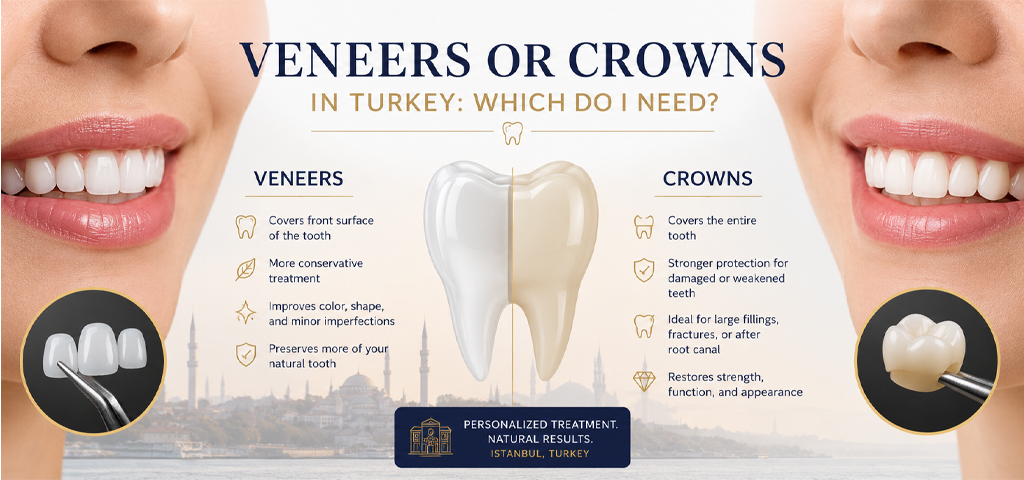
Choosing between veneers and crowns is one of the most important decisions when planning a smile makeover in Turkey. Although both treatments can improve the appearance of teeth, they are not interchangeable. Veneers mainly cover the visible front surface of a tooth, while crowns cover most or all of the tooth and generally require more tooth preparation.
If your teeth are structurally healthy and your main concerns are their colour, shape, size, minor gaps or certain aesthetic imperfections, veneers may be the more conservative option. Crowns are more commonly considered when a tooth has significant structural damage, a large existing restoration, severe wear, a fracture or another condition that requires greater coverage and protection.
The right choice should therefore not be based simply on which treatment creates a more dramatic smile transformation or which material is more popular. The priority is to determine how much healthy tooth structure can be preserved while achieving a functional, natural-looking and sustainable result. Some patients may need veneers, others may genuinely benefit from crowns, and in certain cases a combination of treatments may be appropriate.
What Is the Main Difference Between Veneers and Crowns?
The main difference between a veneer and a crown is how much of the natural tooth each restoration covers. A veneer is a thin restoration bonded primarily to the front surface of the tooth. Because it does not normally need to surround the entire tooth, it can often preserve more natural tooth structure when used in appropriately selected cases.
A dental crown provides much more extensive coverage. It surrounds most of the visible portion of the tooth and may be recommended when the remaining tooth structure needs additional support or when a veneer alone would not provide an appropriate restoration.
This distinction is particularly important for patients considering cosmetic dental treatment. A crown should not simply be thought of as a “stronger veneer.” Veneers and crowns have different indications, and the condition of the natural tooth should determine which approach is appropriate.
For example, a patient with healthy teeth who wants to improve tooth proportions, colour and minor irregularities may be a candidate for veneers. A patient with heavily restored, fractured or significantly weakened teeth may require crowns instead. This is why two people seeking a similar-looking smile can receive very different treatment plans.
When Are Veneers the Better Choice?
Veneers may be suitable when the teeth are generally healthy but their appearance could be improved. They are commonly considered for concerns such as persistent discolouration, uneven tooth shape, small gaps, worn edges, minor size differences or certain mild alignment irregularities.
One of the main advantages of veneers is their potential to provide aesthetic improvement while preserving more of the natural tooth compared with a full-coverage crown. This is particularly relevant when sufficient healthy enamel remains, as enamel can provide a favourable bonding surface for porcelain veneers.
However, veneers are not appropriate for every cosmetic concern. The dentist also needs to evaluate the patient’s bite, tooth position, enamel quality, existing fillings or restorations, wear patterns and habits such as teeth grinding. If a tooth is significantly weakened or there is insufficient healthy structure for predictable bonding, another restorative approach may be more appropriate.
The goal should therefore not be to place veneers on as many teeth as possible. It should be to identify which teeth actually require treatment and choose the least invasive approach that can reasonably achieve the desired aesthetic and functional result.
When Is a Dental Crown Actually Necessary?
A dental crown may be necessary when a tooth has lost enough healthy structure that a more conservative restoration would not provide adequate support, protection or function. Unlike veneers, which are primarily used to modify the visible surface of a tooth, crowns provide more extensive coverage and can help restore teeth that are significantly compromised.
Crowns may be considered for teeth with large existing fillings, substantial fractures, advanced wear or extensive loss of tooth structure. They may also be appropriate for some root canal-treated teeth, particularly when the remaining tooth structure is weakened and requires additional protection. However, having a root canal does not automatically mean that every tooth needs a crown; the decision depends on factors such as the location of the tooth, the amount of remaining structure and the forces placed on it.
The decision should always begin with the condition of the individual tooth. If sufficient healthy enamel and tooth structure remain, a more conservative treatment may sometimes be possible. If the tooth is already heavily damaged or restored, a crown may offer a more appropriate way to restore its shape, strength and function.
This is particularly important during a full smile makeover. Not every visible tooth necessarily requires the same restoration. One patient may benefit primarily from veneers, another may require crowns, while some patients may need a carefully planned combination of veneers, crowns and other treatments.
Do Veneers Require Shaving Your Teeth?
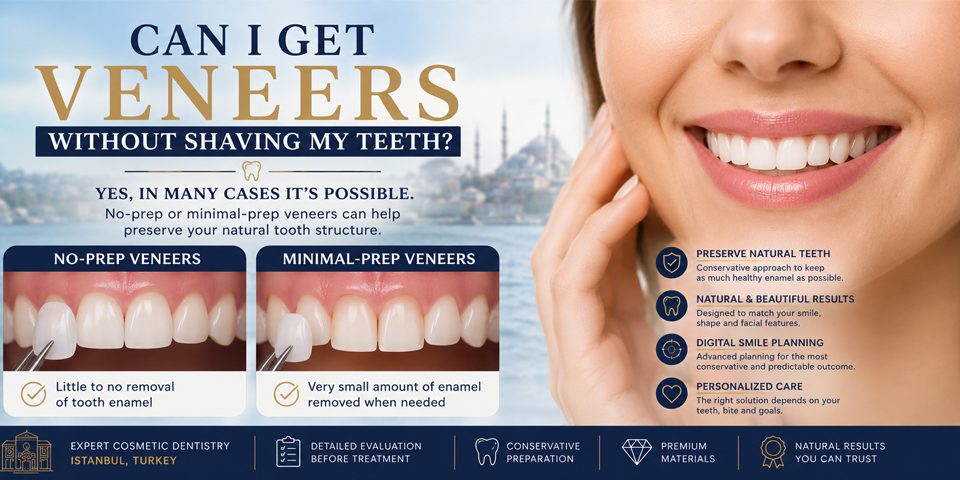
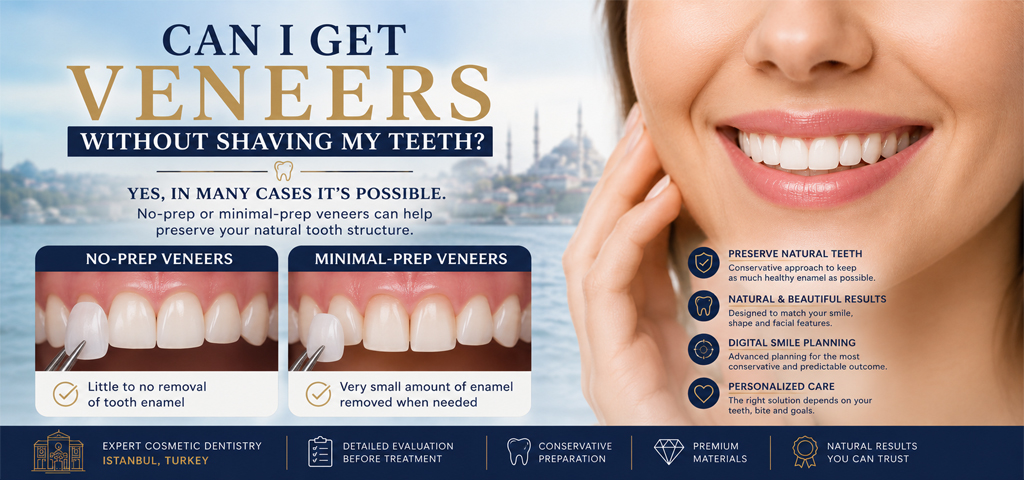
Veneers usually require some degree of tooth preparation, but this does not necessarily mean that the teeth need to be aggressively shaved down. The amount of preparation varies considerably depending on the position, shape, colour and alignment of the natural teeth, as well as the type of veneer and the aesthetic result being planned.
In suitable cases, porcelain veneers can be prepared with a relatively conservative approach, removing only the amount of tooth structure necessary to create space for the restoration and achieve the desired contour. Some patients may even be suitable for minimal-preparation approaches. However, “no-prep veneers” are not appropriate for everyone, and placing additional material onto a tooth without creating sufficient space can sometimes result in teeth that appear bulky or unnatural.
The objective is therefore not simply to remove as little tooth structure as possible at all costs. The aim is to preserve healthy enamel while creating enough space for the ceramic restoration to achieve appropriate thickness, shape, position and appearance.
The original position of the teeth plays an important role. For example, a tooth that already projects outward may require more preparation than a slightly recessed tooth. Significant discolouration, previous restorations and changes in tooth proportions can also influence how much preparation is required.
Patients considering veneers in Turkey should therefore be cautious about assuming that every veneer procedure involves the same amount of tooth reduction. A personalised assessment is necessary to determine whether veneers are appropriate and how conservatively the teeth can be prepared.
Do Crowns Require More Tooth Reduction?
Crowns generally require more tooth preparation than veneers because the restoration needs to cover the tooth more extensively. The tooth is prepared around multiple surfaces to create sufficient space and an appropriate shape for the crown.
This does not mean that crowns are inherently a poor treatment choice. When a tooth is significantly weakened, fractured or already contains extensive restorations, the additional coverage provided by a crown may be clinically appropriate. In such situations, attempting to use a veneer simply because it requires less preparation would not necessarily be the more conservative treatment in the long term.
The important distinction is whether the amount of tooth reduction is justified by the condition of the tooth. Preparing a heavily compromised tooth for a crown is very different from removing substantial healthy tooth structure solely to achieve a cosmetic change.
For patients seeking a smile makeover, this is one of the reasons why treatment planning should take place tooth by tooth rather than automatically applying the same restoration to every tooth in the smile.
Why Are Some Patients Offered Crowns Instead of Veneers?
A patient may be offered crowns instead of veneers when the existing condition of the teeth requires more extensive restoration. Teeth with large fillings, fractures, significant wear, previous crowns or substantial structural damage may not provide the ideal foundation for veneers. In these situations, crowns can offer the coverage needed to restore both function and appearance.
Tooth position can also influence the recommendation. If teeth are severely misaligned, protruding or have significant differences in shape and position, achieving the desired result with veneers alone may not always be possible. In some cases, orthodontic treatment before cosmetic dentistry can provide a more conservative alternative and reduce the amount of tooth preparation required.
However, crowns should not automatically be selected simply because a patient wants a major cosmetic transformation. If the teeth are healthy and the primary concerns are colour, proportion, minor spacing or shape, it is worth evaluating whether a more conservative treatment can achieve the desired result.
This is why patients should understand what is being proposed before beginning treatment. Rather than focusing only on the final appearance, ask why a crown or veneer has been recommended for each tooth, how much natural tooth structure needs to be removed and whether a less invasive alternative is appropriate.
Can Healthy Teeth Be Crowned for a Smile Makeover?
Healthy teeth do not automatically need crowns simply because a patient wants to improve their smile. When teeth have good structural integrity and sufficient enamel, veneers, orthodontics, whitening, bonding or a combination of conservative treatments may sometimes achieve the desired improvement while preserving more natural tooth structure.
There are situations in which the position, bite or shape of a tooth makes treatment more complex, so it would be inaccurate to say that a crown should never be considered for a tooth that appears healthy. The decision requires a clinical examination and should take into account the entire mouth rather than appearance alone.
For patients planning cosmetic dental treatment in Turkey, an important question is not simply, “How many crowns or veneers do I need?” A better question is, “Why does each tooth need this particular treatment?”
A personalised smile makeover does not necessarily mean placing the same restoration on every visible tooth. One tooth may need a crown because it has already lost significant structure, while the adjacent healthy tooth may be better suited to a veneer. Another tooth may not need restorative treatment at all.
Preserving healthy natural tooth structure whenever clinically appropriate is an important principle of modern restorative and cosmetic dentistry. The treatment plan should therefore balance the patient’s aesthetic goals with tooth preservation, bite function and the existing condition of each tooth.
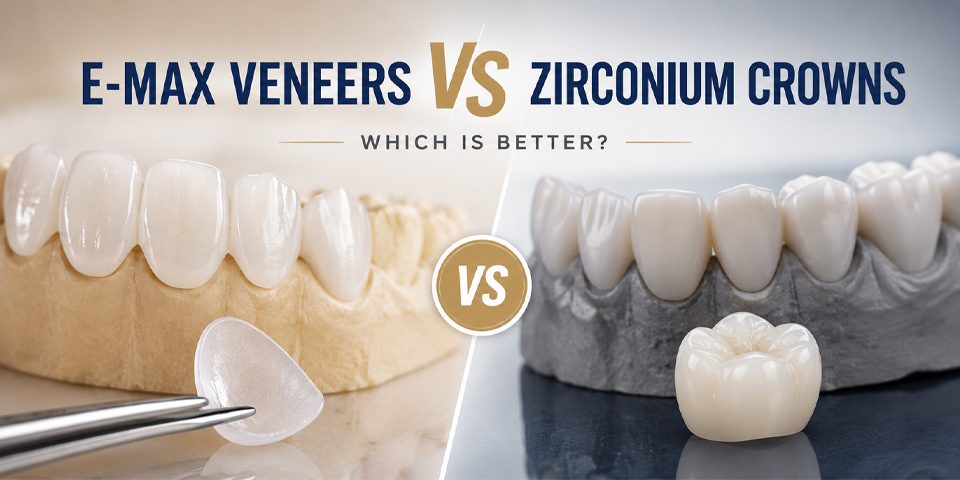
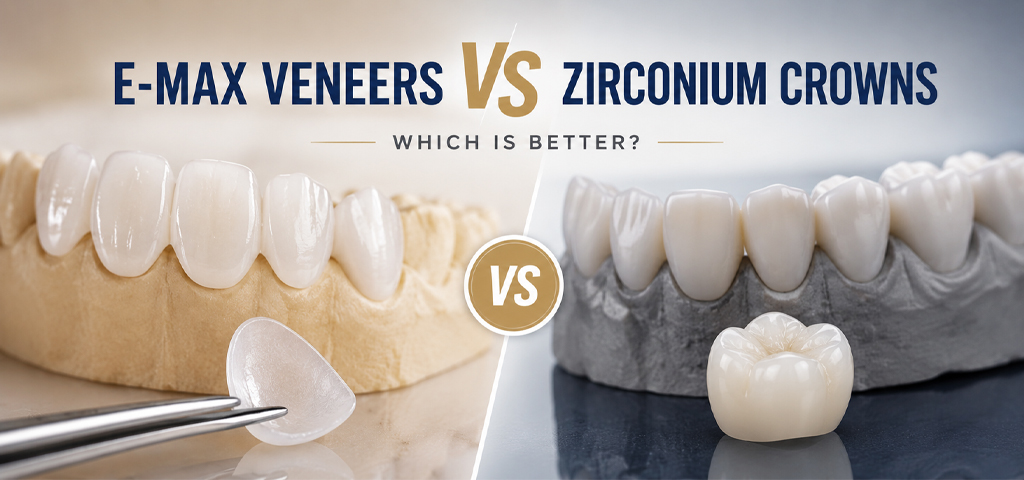
E-Max Veneers or Zirconium Crowns?
E-Max and zirconium are materials, while veneers and crowns describe different types of restorations. This distinction is important because patients sometimes compare “E-Max” and “zirconium” as though they are simply two versions of the same treatment.
E-Max is a lithium disilicate ceramic known for its optical properties and is commonly used for aesthetic restorations, including veneers and certain crowns. Its ability to reproduce translucency and subtle variations in colour can make it particularly useful in highly visible areas when the clinical conditions are suitable.
Zirconia is another dental ceramic valued for its mechanical properties and is widely used for crowns and bridges. Modern zirconia materials are available in different levels of strength and translucency, allowing dentists and dental technicians to select the material according to the location of the restoration, functional demands and aesthetic requirements.
The choice should therefore not begin with “E-Max or zirconium?” Before selecting the material, the dentist first needs to determine what type of restoration the tooth actually requires.
A healthy tooth that is suitable for a conservative veneer should not automatically receive a full-coverage crown simply because a particular material has been requested. Similarly, a significantly compromised tooth should not receive a veneer solely because the patient prefers E-Max veneers.
Treatment type comes first; material selection follows the clinical requirements and aesthetic objectives of that treatment.
Veneers vs Crowns: Which Looks More Natural?
Both veneers and crowns can look natural when they are correctly indicated, carefully planned and well made. A natural result depends less on whether the restoration is called a veneer or a crown and more on factors such as tooth preparation, ceramic selection, colour, translucency, surface texture, proportions and how the new teeth relate to the patient’s face and surrounding natural teeth.
Veneers can provide highly natural results because they are often thin and may allow some of the underlying tooth structure to contribute to the final optical effect. This can be particularly valuable when healthy enamel is present and the goal is to make subtle changes to colour, shape or proportion.
Crowns can also achieve a natural appearance, especially with modern ceramic materials. The challenge is not simply to create teeth that are white and symmetrical. Natural teeth contain subtle variations in translucency, texture, brightness and shape. Reproducing these characteristics requires individual planning rather than applying the same tooth design to every patient.
The surrounding features are equally important. Tooth length and width, gum levels, smile line, lip movement, facial proportions and even the amount of tooth visible when speaking can influence whether a smile feels natural. A shade that looks attractive on one patient may appear artificial on another.
For this reason, the goal of a smile makeover should not necessarily be to create the whitest, largest or most perfectly identical teeth possible. A successful aesthetic result should complement the individual patient while maintaining appropriate function and respecting the condition of the natural teeth.
How Does a Dentist Decide Which Treatment You Need?
The decision between veneers and crowns should be based on a clinical assessment of each tooth rather than on a predetermined smile package. The dentist evaluates how much healthy tooth structure remains, the quality and quantity of enamel, existing fillings or crowns, fractures, wear, tooth position and the patient’s bite.
Aesthetic goals are considered alongside these clinical findings. The dentist needs to understand what the patient wants to change, whether the concern involves colour, shape, spacing, alignment, tooth length or several factors together. Photographs and digital records can help analyse the smile in relation to the lips and face rather than looking at individual teeth in isolation.
The bite is particularly important. Teeth are exposed to repeated forces every day, and the way the upper and lower teeth contact can influence both treatment selection and restoration design. Signs of grinding or clenching, significant tooth wear and certain bite relationships may need to be addressed during treatment planning.
Existing dental work also matters. A tooth with extensive fillings or an old crown presents a different clinical situation from an untouched tooth with healthy enamel. This is why two neighbouring teeth may require different treatments even when they will ultimately need to look harmonious within the same smile.
In some cases, the most appropriate plan may involve treatments other than veneers or crowns. Whitening may be sufficient when colour is the main concern, orthodontic treatment may improve tooth position without extensive preparation, and composite bonding may be suitable for certain minor shape corrections. Cosmetic dentistry should therefore begin with diagnosis and treatment planning rather than choosing a restoration in advance.
Can I Know What I Need Before Travelling to Turkey?
An initial assessment may often be possible before travelling to Turkey, but a remote evaluation cannot replace a complete clinical examination. Clear photographs, recent dental X-rays and information about previous dental treatments can help the dentist understand the general condition of the teeth and discuss possible treatment options.
For an international patient, this preliminary stage can be particularly useful. It can help determine whether the case appears more suitable for veneers, crowns or another treatment and whether additional procedures may need to be considered. It also gives the patient an opportunity to ask why particular treatments are being proposed before arranging the trip.
However, the final treatment plan may change after an in-person examination. The dentist may need to evaluate the teeth, gums and bite directly and review diagnostic imaging before confirming which teeth require treatment and how they should be restored.
Patients should therefore view an online assessment as the beginning of treatment planning rather than a definitive diagnosis. If a precise number of veneers or crowns is proposed remotely, it is reasonable to ask what information that recommendation is based on and whether the plan will be confirmed after a clinical examination in Istanbul.
Choosing Between Veneers and Crowns in Turkey
If you are considering veneers or crowns in Turkey, the most important part of the process is not choosing a treatment package or deciding how many teeth you want to change. It is understanding why a particular treatment has been recommended for your individual teeth.
Before proceeding, you should have a clear explanation of which teeth need treatment, whether veneers or crowns are proposed, how much tooth preparation is expected and why that approach is considered appropriate. If several healthy teeth are being prepared, it is reasonable to ask whether more conservative alternatives could achieve your goals.
The treatment plan should also consider your bite, existing dental work, gum health, tooth position and long-term function. A smile can look attractive in photographs but still needs to feel comfortable when speaking and eating. Aesthetic planning and functional planning should therefore be considered together.
For international patients, communication before travelling is also important. Providing clear photographs, relevant dental history and recent X-rays when available can make the preliminary assessment more informative. Once you arrive in Istanbul, the proposed plan should be confirmed through an in-person examination before irreversible treatment begins.
Ultimately, the question is not whether veneers are better than crowns or crowns are better than veneers. The appropriate restoration is the one that addresses the condition of each tooth while preserving healthy natural tooth structure whenever clinically possible and achieving a result that fits your smile.
Frequently Asked Questions
Are veneers better than crowns?
Neither treatment is universally better. Veneers can be a more conservative option for structurally healthy teeth when the main objective is aesthetic improvement, while crowns may be more appropriate for teeth that are significantly weakened, damaged or heavily restored. The condition of the individual tooth should determine the treatment.
Should I get veneers or crowns for healthy teeth?
If your teeth are healthy and you primarily want to change their colour, shape, size or certain minor irregularities, veneers or other conservative treatments may be considered before full-coverage crowns. However, your bite, tooth position, enamel and existing dental work must also be evaluated before deciding.
Are teeth shaved down for veneers in Turkey?
Veneers generally require some degree of preparation, but the amount varies from patient to patient. Suitable cases may allow relatively conservative preparation, while other teeth may require more modification because of their position, colour or shape. Veneer treatment does not automatically mean that teeth must be extensively reduced.
Can I get veneers without shaving my teeth?
Minimal-preparation or, in selected situations, no-preparation veneers may be possible, but they are not suitable for everyone. Adding porcelain without creating sufficient space can make some teeth appear bulky. The dentist must assess tooth position, enamel, proportions and the desired result before recommending this approach.
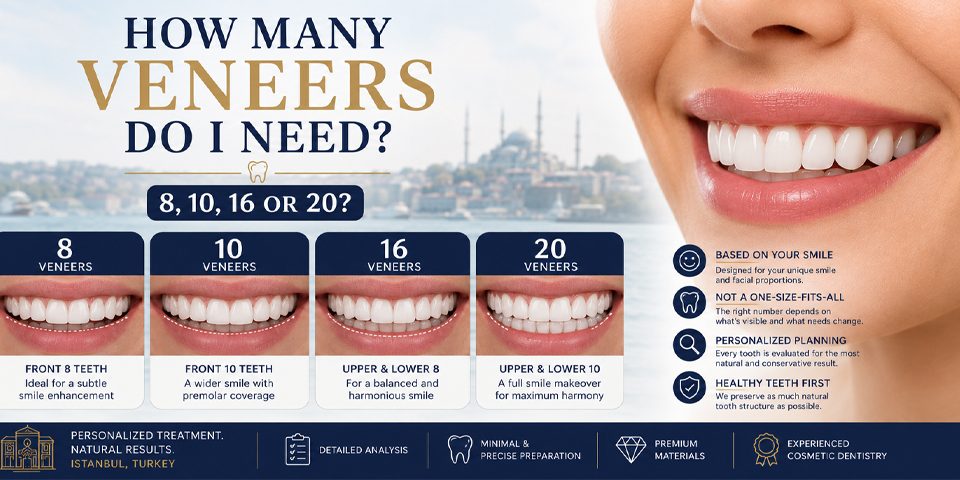
How many veneers or crowns will I need?
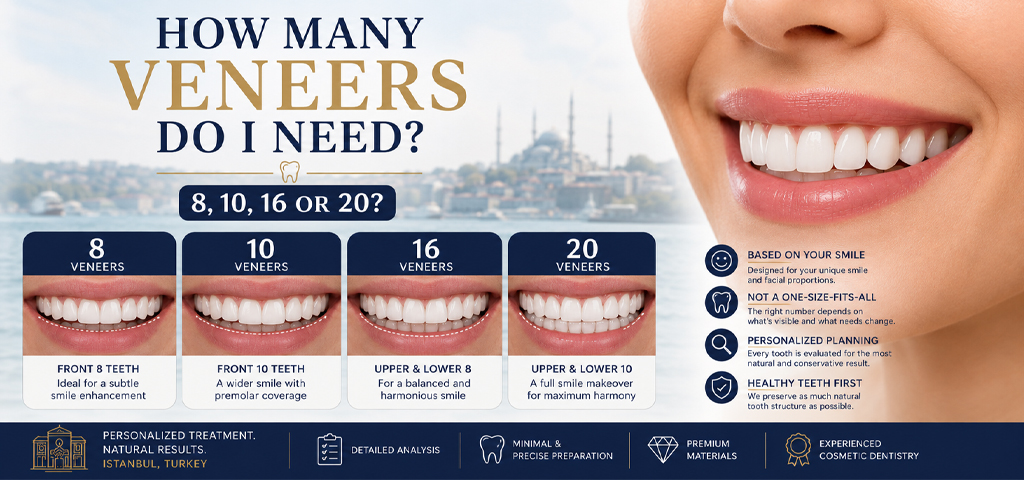
There is no standard number that is appropriate for every smile makeover. The number depends on factors such as how many teeth show when you smile, the condition of those teeth, your smile width, tooth colour and the changes you want to achieve. Some patients may need treatment only on selected teeth, while others may require a broader plan.
Can I have veneers on some teeth and crowns on others?
Yes. A combination can be appropriate when different teeth have different structural conditions. For example, a healthy tooth may be suitable for a veneer while an adjacent tooth with extensive previous treatment may require a crown. The restorations can then be planned together to create a harmonious appearance.
How long do veneers and crowns last?
There is no fixed lifespan that applies to every veneer or crown. Longevity depends on the condition of the underlying teeth, treatment planning, material selection, bite forces, oral hygiene, grinding or clenching habits and ongoing dental care. Both restorations may eventually require maintenance or replacement.
Can I send photos before travelling to Istanbul?
Yes. Clear dental photographs, information about previous treatments and recent X-rays can help with a preliminary evaluation before you travel. This can provide an initial idea of possible treatment options, but the final diagnosis and treatment plan should be confirmed after an in-person clinical examination.
Making the Right Decision for Your Smile
If you are deciding between veneers and crowns, start with the condition of your natural teeth rather than the name of the treatment. Healthy teeth with aesthetic concerns and heavily restored or structurally weakened teeth should not automatically receive the same approach.
A carefully planned smile makeover considers what needs to change, what should remain untouched and how much healthy tooth structure can reasonably be preserved. The final decision should be made after evaluating your teeth, gums, bite, existing restorations and aesthetic expectations together.
If you are considering cosmetic dental treatment in Istanbul, you can send clear photographs of your teeth and recent dental X-rays, if available, for an initial assessment. This preliminary evaluation can help identify possible treatment options before your visit, while the final treatment plan is confirmed following a clinical examination.