

Cosmetic Dentistry in Turkey: Treatment Options

Dental Check-Up in Istanbul: What to Expect
17 September 2026
Cosmetic Dentistry Cost in Turkey
17 September 2026
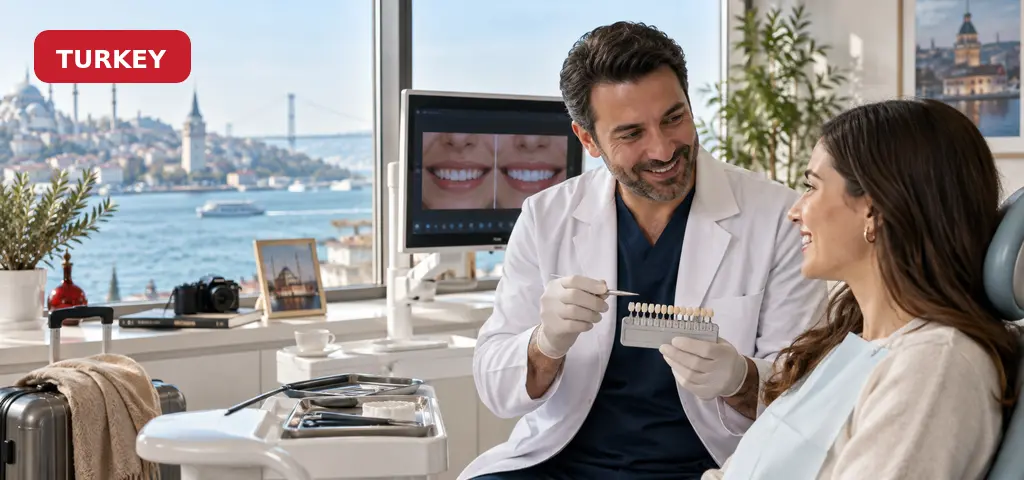
Cosmetic dentistry in Turkey can include whitening, composite bonding, veneers, crowns or orthodontic treatment. Each changes something different: colour, tooth shape, surface appearance, structural support or tooth position. The appropriate choice depends on your oral health and the specific change you want to make.
Begin by describing your concern rather than choosing a full set of restorations. A dentist can explain suitable options, including whether a smaller intervention or no elective treatment is reasonable. The aim is an informed decision about your own teeth.
Identify the concern before choosing a procedure
Try to separate colour, shape, position and function in your description. “My front tooth is darker” is a different concern from “my teeth are crowded” or “an edge has chipped.” They may look similar in a photograph but call for different assessments.
Tell the dentist about pain, sensitivity, gum bleeding and previous treatment as well as appearance. Decay or gum disease needs assessment and appropriate care before elective veneers are considered. Covering a tooth does not remove the need to address an underlying problem.
Bring examples of what you would like to change, while recognising that another person’s teeth are not a prescription for yours. Ask the dentist to explain which parts of your goal are achievable and which limitations would remain.
Whitening for a concern about natural tooth colour
Teeth whitening lightens natural tooth colour using a bleaching product. It does not move teeth or change their shape. Different causes of discolouration respond differently, so an assessment is needed before selecting a method.
Existing crowns, veneers and fillings do not whiten like natural teeth. If they are visible, discuss how a change to neighbouring tooth colour could affect the match. Their replacement, if considered, is a separate decision.
Ask whether your concern is surface staining, natural tooth colour or a change in one particular tooth. Professional cleaning and whitening have different purposes, and a dark tooth may need investigation rather than an automatic bleaching course.
Composite bonding for selected shape changes and repairs
Composite bonding uses tooth-coloured resin to make selected repairs or changes to a tooth’s shape. It may be considered for a small chip, an uneven edge or certain gaps. The material is applied, shaped, hardened and polished.
The amount of preparation depends on the tooth and intended change. Ask what would be added, whether any tooth structure would be removed and how the proposed shape fits your bite. Adding material is not automatically appropriate where it would create an unsuitable contour.
Discuss maintenance as well as the initial appearance. Composite may need polishing, repair or replacement over time. Ask what can realistically be changed on each tooth and how any future damage would be assessed.
Veneers and crowns cover different parts of a tooth
Laminate veneers cover mainly the front surface of teeth. They can alter the visible surface, but usually involve enamel preparation and are not a reversible cosmetic accessory. Existing enamel, restorations, gum health and bite influence suitability.
A crown covers a prepared tooth more extensively. It may help restore a tooth weakened by a large filling or significant damage. It should not be assumed to be the next step simply because a patient wants a cosmetic change.
Ask which restoration is proposed for each tooth and why. Healthy teeth and heavily restored teeth may need different approaches within the same plan. Avoid treating the words “veneer” and “crown” as interchangeable descriptions of the same preparation.
For either restoration, discuss the amount of tooth structure involved and possible future maintenance. Veneers can chip, wear or loosen, and crowns also need ongoing care. Material choice does not remove the importance of diagnosis and follow-up.
Orthodontics changes tooth position
If crowding, spacing or the way teeth meet is the main concern, orthodontic assessment may be appropriate. Braces and aligners move teeth; restorations change the surfaces or shapes of teeth. Changing the appearance of alignment with restorations is not the same as correcting tooth position.
Orthodontic treatment may be suitable for adults as well as younger patients. The appliance and approach depend on the assessment. Retainers are used to preserve and stabilise the result after active tooth movement.
Ask whether movement could address the main concern before choosing restorative work. If a combined approach is suggested, clarify what each part is intended to achieve rather than assuming all parts must be accepted together.
Compare options by what they actually change
The table below is a starting point for questions, not a self-selection tool. Suitability still requires an examination and discussion of your priorities.
| Option | What it mainly changes | Question to ask |
|---|---|---|
| Whitening | Natural tooth colour | Will the cause of my discolouration respond, and what about existing restorations? |
| Composite bonding | Selected edges, shape or small defects | What will be added or prepared, and what maintenance is expected? |
| Veneers | The visible front surface | How much enamel preparation is involved, and why is this suitable? |
| Crowns | The form and coverage of a prepared tooth | What structural or restorative reason supports full coverage? |
| Orthodontics | Tooth position and bite relationships | What can movement achieve, and what retention will be needed? |
For a mixed plan, request an explanation by tooth or area. Note the goal, proposed procedure and alternative for each. This makes it easier to see whether a recommendation addresses your main concern or introduces an additional change you have not yet discussed.
Agree the limits, stages and maintenance before starting
Ask what the proposed care can change and what it cannot. A preview, photograph or model can support a discussion when used, but it should not be treated as a promise of every detail of the final result. Clarify which features can be evaluated before irreversible preparation.
If more than one procedure is recommended, ask for the sequence and purpose of each stage. Also discuss cleaning, review and possible future repair. For questions about inclusions rather than clinical options, use the separate cosmetic treatment scope guide.
Keep the plan in language you understand. If the recommendation changes after assessment, ask for the reason and alternatives before deciding on the next step. You can also choose to defer elective treatment while considering the information.
Frequently asked questions
What treatments are included in cosmetic dentistry?
The term can include whitening, bonding, veneers, crowns and orthodontic treatment. The appropriate option depends on the concern and clinical findings rather than a standard makeover formula.
Do I need veneers to improve tooth colour?
Not necessarily. Whitening or another approach may be appropriate depending on the cause of the colour concern. Existing restorations and the condition of the teeth need to be considered.
Is bonding the same as a porcelain veneer?
No. Bonding uses material applied and shaped directly on the tooth, while a porcelain veneer is a custom-made shell. Preparation, maintenance and suitability differ.
Are crowns and veneers interchangeable?
No. A veneer covers mainly the front surface, while a crown covers a prepared tooth more extensively. Ask which is proposed for each tooth and what clinical reason supports it.
Can veneers replace orthodontic treatment?
They do not move teeth. Restorations may change the visible shape or surface, while orthodontics changes position. An assessment is needed to compare the approaches.
Should decay or gum disease be checked first?
Yes. Oral health needs assessment before elective treatment. Veneers should not be placed over untreated decay or unhealthy gums.
Does every tooth need the same treatment?
No. A plan may use different approaches for different teeth, or leave some untreated. Ask why each tooth is included and whether a smaller intervention is suitable.
Can I decide not to have cosmetic treatment?
Yes. Ask about reasonable alternatives and the implications of leaving the appearance unchanged. You can take time to consider elective treatment before agreeing to it.
Discuss the change you want to make
At an assessment, describe your main concern and mention previous treatment or current symptoms. Ask for suitable options to be explained alongside their limitations so you can decide on a plan you understand.
To contact Dt. Özlem Özcan’s practice, visit the contact page, call +90 212 288 76 48 or send a message through WhatsApp.
Sources and further reading: American Dental Association: Whitening; Canadian Dental Association: Bonding and veneers; American Dental Association: Veneers; American Dental Association: Crowns; American Dental Association: Orthodontics.