

Can I Get Dental Implants With Bone Loss?

How Long Should I Stay in Turkey for Dental Implants?
4 November 2026
All-on-4 vs All-on-6: Which Is Better?
4 November 2026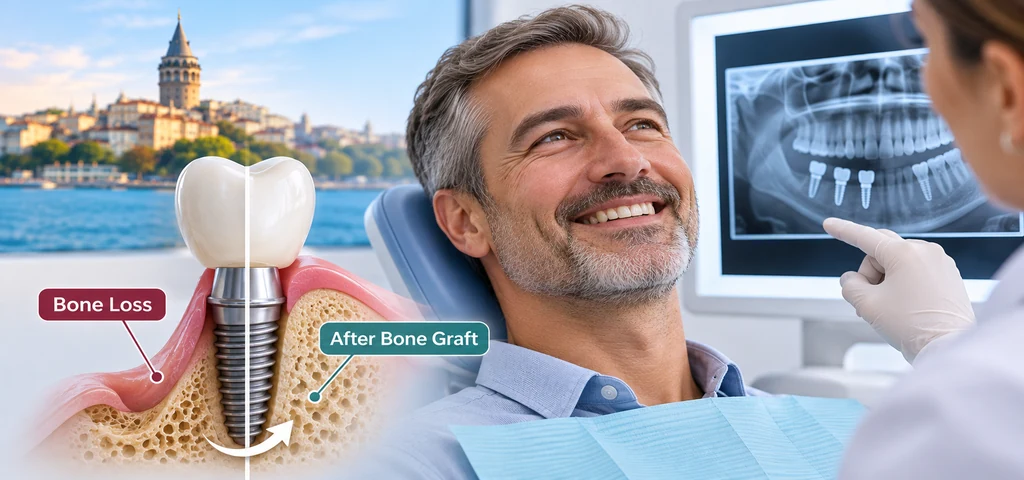
Yes, dental implants may still be possible if you have experienced jawbone loss. However, the amount, location and quality of the remaining bone determine whether conventional implant placement is appropriate or whether additional treatment is required.
Many patients believe that losing jawbone automatically means they cannot receive dental implants. In reality, modern implant treatment offers several approaches for patients with reduced bone volume. These may include bone augmentation, sinus floor elevation, alternative implant dimensions or carefully planned restorative solutions.
Not every option is suitable for every patient. Some people can receive implants without additional bone procedures, while others require grafting or a staged treatment plan. In certain circumstances, conventional implant placement may not be advisable.
Bone loss is particularly common among patients who have been missing teeth for several years, have experienced periodontal disease or have previously worn removable dentures. The longer a tooth remains missing, the more the surrounding jawbone may change because it no longer receives the same functional stimulation through a natural tooth root.
For international patients considering dental treatment in Turkey, understanding bone loss is especially important. The condition may influence the number of appointments, the type of surgery, healing requirements and whether treatment can be completed during one or several visits.
At the practice of Dt. Özlem Özcan in Istanbul, an appropriate implant assessment involves evaluating the available bone, surrounding teeth, gum health and overall oral condition before determining which treatment options may be suitable.
This guide explains how bone loss affects implant treatment, when bone grafting may be considered, what alternatives exist and how patients travelling to Istanbul can prepare for a realistic treatment plan.
Can You Have Dental Implants if You Have Lost Jawbone?
Dental implants need sufficient support from the surrounding jawbone to achieve stability and function appropriately. However, reduced bone volume does not necessarily prevent treatment.
The key question is whether the remaining bone provides a suitable foundation for the proposed implant or whether the treatment site can be modified safely.
Bone loss can affect the height, width or shape of the jawbone. Some patients have adequate bone height but insufficient width. Others have experienced vertical bone loss that places important anatomical structures closer to the proposed implant position.
The severity of the condition also varies. Mild bone loss may not require additional procedures if the remaining bone is suitable for the selected implant. More extensive defects may require bone augmentation or an alternative treatment approach.
The dentist must consider the intended position of the replacement tooth, not simply whether an implant can physically fit into the available bone.
An implant placed in an unsuitable position may create problems with the final restoration, cleaning access, appearance or the forces transmitted during chewing.
For this reason, implant planning begins with a comprehensive examination and appropriate imaging rather than choosing an implant size based only on the available space.
Patients interested in dental implants in Istanbul should understand that the treatment objective is to create a stable, maintainable restoration supported by healthy surrounding tissues.
A personalised assessment is essential because two patients with similar-looking missing teeth may have very different bone conditions.
Why Does Jawbone Loss Happen?
Jawbone loss can develop for several reasons. Identifying the underlying cause helps the dentist determine whether implant treatment is appropriate and whether additional measures are necessary.
Missing Teeth and Bone Resorption
Natural tooth roots are surrounded by bone that adapts to the forces generated during normal chewing.
When a tooth is extracted or lost, the surrounding alveolar bone undergoes remodelling. Because the tooth root is no longer present, the ridge may gradually become narrower or lower.
Bone changes often occur relatively rapidly after extraction, particularly during the early healing period, although the pattern and extent vary between patients.
Over time, the shape of the jawbone may change enough to complicate implant placement.
This is one reason why replacing a missing tooth several years after extraction may require a different approach from treatment performed soon after tooth loss.
However, placing an implant does not guarantee that all future bone changes will be prevented. The long-term condition of the surrounding tissues still depends on biological, mechanical and maintenance factors.
Periodontal Disease
Periodontal disease affects the tissues supporting natural teeth, including the gums and surrounding bone.
Advanced periodontitis can lead to progressive destruction of supporting bone and may eventually contribute to tooth mobility or tooth loss.
Patients with a history of periodontal disease may still be candidates for implants, but active disease should be addressed before surgery.
A previous history of periodontitis is also relevant because these patients may have an increased risk of inflammatory complications around implants, particularly when plaque control and maintenance are inadequate.
The dentist should therefore evaluate periodontal stability, oral hygiene and the patient’s ability to maintain the proposed restoration.
Dental Infections and Trauma
Long-standing dental infections can damage the bone around tooth roots.
In some cases, an infection associated with a severely damaged tooth creates a localised defect that remains after extraction.
Traumatic injuries may also affect the shape or volume of the jawbone, especially when teeth and surrounding bone are damaged together.
These conditions can influence the timing of implant placement and whether reconstruction is required.
Long-Term Denture Use
Patients who have worn removable dentures for many years may experience progressive changes in the underlying jawbone.
Conventional dentures rest on the soft tissues covering the ridge and do not reproduce the biological function of natural tooth roots.
As the ridge changes, dentures may become less stable or require adjustment.
Some patients seek implant treatment because they experience difficulty chewing, speaking or keeping their dentures in place.
However, long-term denture use can also mean that the available bone requires careful assessment before implants are considered.
Other Contributing Factors
Bone metabolism, age-related changes, systemic health conditions, previous surgery and certain medications can influence the condition of the jawbone.
Age alone does not determine implant eligibility. The patient’s general health, oral condition and ability to heal are often more relevant than chronological age.
The dentist must consider these factors alongside the local bone anatomy when planning treatment.
How Much Bone Do You Need for Dental Implants?
There is no single bone measurement that determines whether every patient can receive a dental implant.
The amount of bone required depends on the implant system, proposed diameter and length, anatomical location, restorative design and proximity to important structures.
A conventional implant must be positioned within an appropriate volume of bone while respecting nearby anatomical structures.
In the lower jaw, particular attention is given to the inferior alveolar nerve and other relevant anatomy. In the upper posterior jaw, the maxillary sinus may limit the available vertical bone.
The dentist must also consider the thickness of bone around the implant and the expected relationship between the restoration and surrounding soft tissues.
Bone quality matters as well as quantity. Two sites with similar dimensions may behave differently during surgery because of differences in bone density and structure.
A site with adequate height but insufficient width may require horizontal augmentation. A site with limited vertical bone may require a different procedure or implant configuration.
For patients replacing visible front teeth, the contour of the surrounding bone and gums is particularly important for the appearance of the final restoration.
The objective is not merely to place an implant into the jaw. It is to create a restoration that can function appropriately and remain accessible for effective cleaning.
Because these factors are interconnected, implant suitability cannot be determined reliably from a single photograph or a general statement about bone loss.
How Do Dentists Check Bone Loss Before Implant Treatment?
A clinical examination and appropriate dental imaging are essential for assessing patients with suspected jawbone loss.
The dentist first reviews the patient’s dental and medical history. This may include the duration of tooth loss, previous gum disease, extractions, infections, existing restorations and any previous implant treatment.
The mouth is examined to assess gum health, the remaining teeth, the shape of the dental ridge and the available restorative space.
Dental radiographs may provide information about existing teeth and surrounding structures. When detailed three-dimensional assessment is necessary, cone-beam computed tomography, or CBCT, may be recommended.
CBCT can help the clinician evaluate the height and width of the jawbone, identify anatomical limitations and plan the proposed implant position.
It can also help assess the relationship between the available bone and structures such as the maxillary sinus or mandibular nerve canal.
However, CBCT is not required for every dental concern, and imaging should be selected according to clinical need.
The dentist combines the imaging findings with the examination, proposed restoration and medical history to determine the appropriate treatment approach.
Can You Know if You Need a Bone Graft Before Travelling?
International patients sometimes send existing X-rays or scans to a dental practice before travelling to Turkey.
These records may help with preliminary discussions, particularly when they are recent and provide adequate information.
Nevertheless, a definitive decision about grafting may require an updated examination and appropriate imaging.
A two-dimensional X-ray does not always provide sufficient information about bone width or the precise shape of a defect.
Even when three-dimensional imaging is available, the final treatment decision must consider clinical findings and the intended restorative outcome.
Patients should therefore avoid assuming that a remote assessment can guarantee implant placement without grafting.
What Is Bone Grafting for Dental Implants?
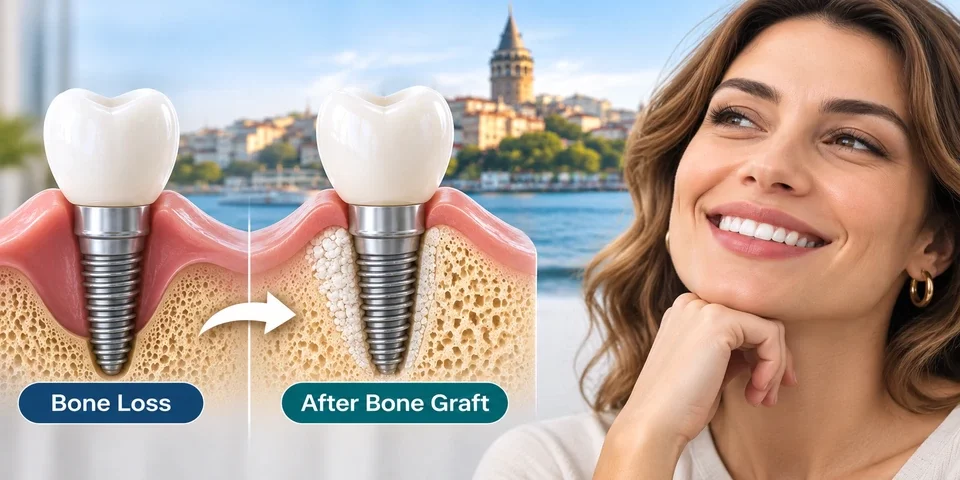
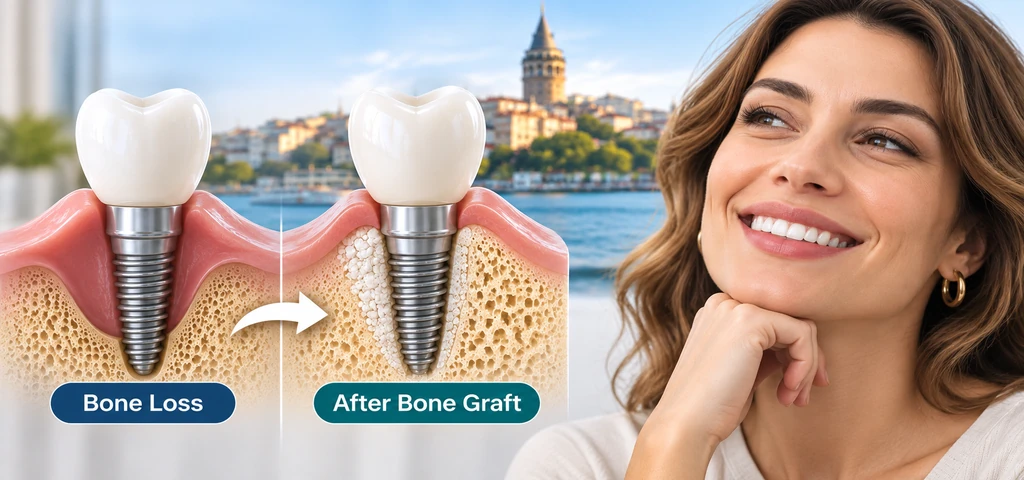
Bone grafting is a procedure used to reconstruct or augment areas where the existing bone does not provide suitable conditions for the planned treatment.
In implant dentistry, the procedure may be recommended to improve the dimensions of the jawbone or support a more appropriate implant position.
Bone augmentation is not one single technique. The approach depends on the type, location and severity of the defect.
Some procedures involve placing grafting material into a relatively small area. Others require more extensive reconstruction or a staged surgical approach.
The grafting material may be derived from the patient’s own bone, a processed human or animal source, or a synthetic substitute, depending on clinical requirements and applicable standards.
These materials have different properties and are selected according to the intended procedure.
In some cases, a barrier membrane is used to protect the grafted area and support the regeneration process.
Bone grafting does not guarantee that sufficient new bone will develop in every patient. Healing outcomes depend on the defect, surgical technique, biological response and other patient-related factors.
The dentist should explain why grafting is being recommended, which material or technique is proposed and whether implant placement can occur during the same procedure.
Can Bone Grafting and Implant Placement Happen Together?
In selected cases, bone grafting can be performed at the same time as implant placement.
This may be possible when the implant can achieve appropriate primary stability in the existing bone and the surrounding defect is suitable for simultaneous augmentation.
For example, a limited bone deficiency around an otherwise stable implant may be managed during the same surgical appointment.
However, when the available bone cannot provide adequate stability or the defect is extensive, staged treatment may be preferable.
The graft is then allowed to heal before implant placement is considered.
The decision depends on clinical findings rather than a patient’s preference to minimise appointments.
How Long Does a Bone Graft Take to Heal?
Bone graft healing is a biological process that takes time.
Depending on the procedure and defect, several months may be needed before the site is suitable for implant placement or further restorative treatment.
A healing interval of approximately three to six months is often discussed for certain augmentation procedures, but more extensive cases may require longer.
The dentist evaluates the site before deciding whether the next treatment stage can proceed.
Patients should understand that the healing period cannot reliably be shortened simply to accommodate a travel schedule.
Can You Get Implants Without a Bone Graft?
Yes. Some patients with reduced bone volume can receive implants without a separate bone graft, depending on the anatomical conditions and restorative requirements.
The dentist may consider an implant with different dimensions, a modified position or another treatment configuration.
However, avoiding grafting should not become the primary objective if it compromises the position, stability or long-term maintainability of the restoration.
Short Dental Implants
Short implants may be considered in selected areas where vertical bone height is limited.
Their suitability depends on the available bone, implant design, intended restoration and expected chewing forces.
They are not appropriate for every patient or anatomical site.
The dentist must assess whether a shorter implant can provide suitable support without creating an unfavourable restorative situation.
Narrow-Diameter Implants
Narrow-diameter implants may be considered when the available bone width is limited.
However, their use depends on the location, restorative requirements and mechanical loading.
A narrow implant is not automatically a substitute for bone augmentation, particularly in areas exposed to substantial chewing forces.
Alternative Implant Positions
In certain complex cases, the dentist may consider an alternative implant arrangement that makes use of available bone.
These approaches require detailed planning and may involve different surgical techniques or restorative designs.
Not all implant configurations are suitable for every patient, and some advanced procedures require additional specialist expertise.
The choice should be based on the patient’s anatomy, clinical needs and the expected function of the final restoration.
What Is a Sinus Lift and When Is It Needed?
A sinus lift, also called sinus floor elevation, is a procedure sometimes used when there is insufficient bone height in the upper back jaw for the planned implant.
The maxillary sinuses are air-filled spaces located above the posterior upper teeth.
After upper molars or premolars are lost, the available bone beneath the sinus may be reduced because of ridge resorption and changes in the sinus floor.
In some cases, this leaves insufficient vertical bone for conventional implant placement.
A sinus lift involves elevating the sinus membrane and, when indicated, placing grafting material to increase the available bone volume.
Different techniques may be used depending on the existing bone height, anatomy and treatment plan.
Some sinus elevation procedures can be performed at the same time as implant placement. Others require a separate healing period before implants are inserted.
The dentist must assess the condition of the sinus and relevant medical history before recommending the procedure.
Patients should also understand that sinus-related surgery may involve specific postoperative precautions, including restrictions on nose blowing, pressure changes or air travel.
The timing of flying after a sinus lift should be determined by the treating surgeon rather than by general travel advice.
Can Severe Bone Loss Be Treated With Dental Implants?
Severe jawbone loss can make conventional implant treatment more complex, but it does not automatically exclude every implant-supported option.
The appropriate approach depends on which parts of the jaw are affected, how much bone remains and whether the proposed restoration can be supported safely.
Some patients may benefit from staged bone reconstruction. Others may be assessed for alternative implant configurations or different restorative solutions.
In the upper jaw, certain advanced implant techniques can use bone outside the areas typically used for conventional implants. These procedures are not routine alternatives for every patient and require specific training, anatomical assessment and careful evaluation of risks.
Patients should be cautious about assuming that a particular technique is suitable simply because it is advertised for severe bone loss.
Extensive implant treatment can involve significant surgical and prosthetic complexity.
The dentist should explain the expected stages, potential complications, maintenance requirements and available alternatives.
For some patients, a removable prosthesis or another form of rehabilitation may provide a more appropriate balance of function, health and treatment burden.
The objective should always be to select a clinically justified approach rather than to pursue implant placement at any cost.
How Does Bone Loss Affect the Dental Implant Treatment Timeline?
Bone loss can significantly influence the number of visits required for implant treatment, especially for patients travelling internationally.
A patient with adequate bone may be able to undergo implant placement during an initial visit, return home for healing and travel back for the definitive restoration.
A patient requiring staged augmentation may need an additional surgical visit before implant placement can occur.
For example, a treatment sequence may involve an initial examination and grafting procedure, several months of healing, a second visit for implant placement and a further healing period before the final restoration.
Not every patient requires this sequence. Some cases allow simultaneous grafting and implant placement, while others need different stages.
This is why patients should distinguish between the time spent in Istanbul for individual appointments and the overall duration of treatment.
How Long Should You Stay in Istanbul After Surgery?
For uncomplicated implant placement, some international patients may be advised to allow several days for early recovery and a postoperative review.
However, the appropriate stay depends on the extent of surgery and the patient’s condition.
If bone grafting or sinus elevation is performed, additional recovery considerations may apply.
The dentist should discuss the expected postoperative course and whether travel restrictions are necessary.
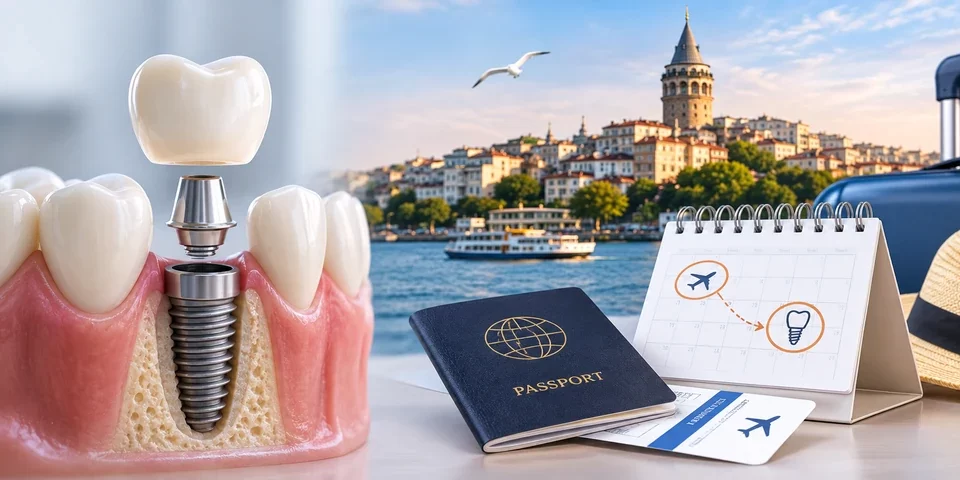
For a detailed explanation of treatment visits and healing periods, see How Long Should I Stay in Turkey for Dental Implants?.
Why a Flexible Travel Schedule Matters
International patients often have limited time away from work and may prefer to arrange all appointments in advance.
While preliminary planning is useful, the final schedule may change after clinical examination.
For example, the dentist may identify a larger bone defect than expected or recommend treating an existing infection before surgery.
A grafted site may also require more healing time than initially anticipated.
Patients should therefore avoid booking multiple treatment stages based solely on an assumed healing interval.
What Are the Alternatives if Implants Are Not Suitable?
Dental implants are one option for replacing missing teeth, but they are not appropriate for every patient.
When implant placement would involve unacceptable risk or extensive treatment that the patient does not wish to pursue, other restorative options should be considered.
A dental bridge may be appropriate in selected situations where neighbouring teeth can provide suitable support.
Conventional bridges usually require preparation of the supporting teeth, although the design depends on the clinical circumstances.
For patients missing several teeth or an entire arch, removable dentures may be considered.
Modern removable prostheses can provide functional and aesthetic benefits, although their stability, comfort and maintenance requirements differ from implant-supported restorations.
The choice depends on the condition of the remaining teeth, bone anatomy, oral hygiene, patient expectations and the overall treatment burden.
If natural teeth remain and are potentially restorable, preserving them may also be an important consideration.
A tooth should not be extracted solely because an implant is available as an alternative.
Where appropriate, restorative treatment such as dental fillings or root canal treatment may help retain natural teeth.
The dentist should explain the advantages, limitations and maintenance needs of the available options so that the patient can make an informed decision.
What Should International Patients Ask Before Travelling to Turkey?
If you have been told that you have bone loss, gathering relevant information before travelling can help you prepare for the clinical assessment.
You may already have recent dental X-rays, a CBCT scan or a treatment recommendation from a dentist in your home country.
Sharing these records, when appropriate, can support an initial discussion. However, the records must be interpreted alongside the clinical examination.
Before arranging travel, it is useful to understand whether the proposed appointment is primarily for assessment or whether surgery may also be possible.
You should also clarify whether bone grafting is being considered, whether the treatment may involve multiple visits and how follow-up care will be managed.
Patients travelling from the United Kingdom, Ireland or other European countries should plan for the possibility that healing may continue for several months between visits.
If you are receiving treatment for a medical condition or taking medication that could affect surgery or healing, inform the dental practice in advance.
A realistic plan should also address what happens if the clinical findings differ from the preliminary assessment.
For patients who have previously been refused implant treatment because of bone loss, a further professional assessment may help clarify whether alternative options exist.
However, a second opinion does not guarantee that implant placement will be appropriate.
The final decision must prioritise safety, biological conditions and the long-term function of the proposed restoration.
Frequently Asked Questions About Dental Implants and Bone Loss
Can I get dental implants if I have severe bone loss?
Possibly. Severe bone loss makes implant treatment more complex, but some patients may be candidates for bone reconstruction or alternative implant approaches. Suitability depends on the remaining anatomy, medical history and restorative requirements. A detailed clinical assessment is essential.
Is bone grafting always necessary when there is bone loss?
No. Some patients have sufficient bone for an appropriately planned implant despite having experienced resorption. Others may be suitable for alternative implant dimensions or configurations. Bone grafting is recommended when clinically necessary, not simply because some bone loss is present.
Can bone grow back naturally after losing a tooth?
The jawbone undergoes natural healing and remodelling after tooth loss, but significant ridge resorption generally does not reverse spontaneously to recreate the original bone dimensions. When additional bone volume is required for treatment, a reconstructive procedure may be considered.
Is there an age limit for dental implants with bone loss?
There is no universal upper age limit based solely on chronological age. General health, oral condition, bone anatomy and the ability to maintain the restoration are more important considerations. Implant treatment is generally deferred until jaw growth is complete in younger patients.
Can I get implants after years of wearing dentures?
Many long-term denture wearers can be assessed for implant treatment. However, prolonged tooth loss may be associated with substantial ridge resorption. The dentist must evaluate the remaining bone and determine whether conventional implants, augmentation or another option is appropriate.
Can dental implants be placed immediately after extraction if bone is missing?
Immediate implant placement may be possible in selected cases, but it depends on the condition of the extraction socket, remaining bone walls and ability to achieve implant stability. Significant defects or infection-related concerns may make a staged approach preferable.
Does a bone graft guarantee successful dental implants?
No. Bone grafting can improve the conditions for implant placement in suitable cases, but graft healing and implant integration cannot be guaranteed. Outcomes depend on the defect, surgical technique, patient-related factors and ongoing maintenance.
How long after bone grafting can I get an implant?
The interval varies according to the grafting procedure and healing response. Several months may be required in staged cases. The dentist should assess the grafted area before deciding whether implant placement can proceed.
Can smoking affect implants when I already have bone loss?
Yes. Smoking is associated with impaired healing and an increased risk of complications around dental implants. Patients who smoke should discuss their habits with the dentist and receive appropriate advice before treatment.
Can I send my dental scan before visiting Istanbul?
You can ask the practice whether your existing records are suitable for preliminary review. A recent CBCT scan may provide useful anatomical information, but a definitive diagnosis and treatment plan still require an appropriate clinical assessment.
Discuss Your Implant Options With Dt. Özlem Özcan in Istanbul
Bone loss does not always mean that dental implants are impossible. The available options depend on the amount and location of the remaining bone, oral health, medical considerations and the type of restoration required.
Some patients can receive implants without additional bone procedures. Others may benefit from grafting or a staged treatment plan, while alternative restorative options may be more appropriate in certain circumstances.
If you have missing teeth and are concerned about jawbone loss, the practice of Dt. Özlem Özcan in Istanbul can help you discuss your dental history and arrange an assessment of the available treatment options.
You can explore the dental implants treatment page for more information about implant procedures and individual treatment planning.
For appointment enquiries and international patient communication, contact the practice through WhatsApp at +90 552 288 76 48 or call +90 212 288 76 48.
A clinical examination and appropriate imaging can help establish whether implants are suitable, whether bone augmentation may be required and which treatment approach best addresses your dental needs.