

Dentures in Turkey
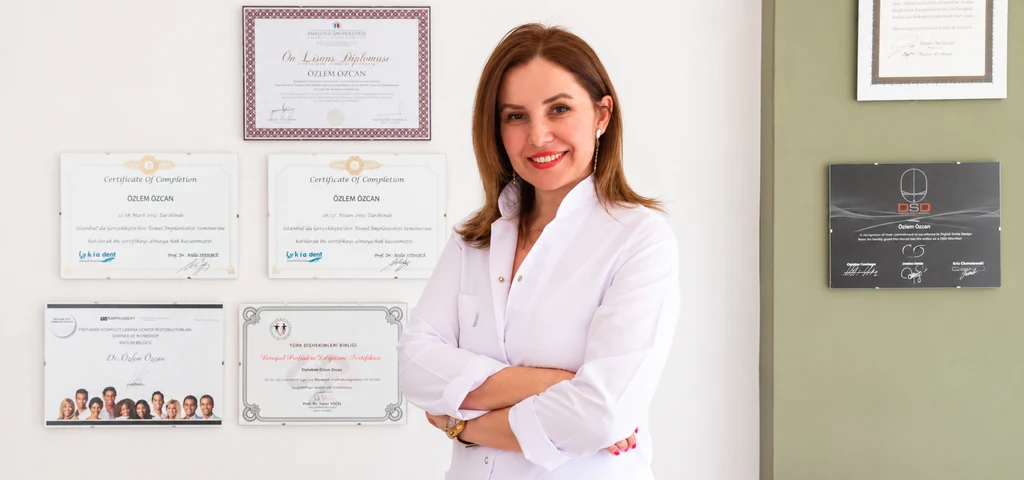
Dentures are removable restorations designed to replace some or all missing teeth and the supporting tissues around them. A complete denture replaces a full arch of teeth, while a partial denture uses the remaining teeth and gums for support and retention. Selected dentures can also attach to dental implants for greater stability. At her clinic in Istanbul, Dt. Özlem Özcan plans the denture around oral health, jaw anatomy, remaining teeth, bite, appearance, speech and the patient’s ability to clean and manage the appliance.
Denture planning based on support, stability, appearance and daily care
For patients considering dentures in Turkey, a natural appearance is only one part of successful treatment. Comfort, retention, chewing, speech, hygiene and the possibility of future relining or repair matter just as much. New dentures also require adaptation; they cannot be expected to feel exactly like natural teeth on the first day. This guide compares conventional, immediate, partial and implant-supported dentures and explains how international patients can plan treatment in Istanbul without treating the fitting appointment as the end of care.

What types of dentures are available?
Dentures are classified by how many teeth they replace, when they are fitted and what supports them. A full or complete denture replaces all teeth in an upper or lower arch. A removable partial denture replaces selected teeth and connects to remaining teeth through clasps, precision attachments or another framework design. An immediate denture is made before teeth are extracted and fitted on the day of removal. An implant-retained or implant-supported denture uses implants to improve retention or support.
These categories can overlap. An immediate denture can be full or partial. An implant overdenture remains removable by the patient even though it attaches to implants. A fixed full-arch implant prosthesis is not a conventional removable denture, even though patients sometimes call every complete set of artificial teeth “dentures.” Understanding whether a restoration is removable, fixed, tissue-supported or implant-supported is essential before comparing proposals.
The correct option depends on the number and condition of remaining teeth, ridge anatomy, gum health, available bone, manual dexterity, hygiene, expectations and whether surgery is acceptable. A person who has stable natural teeth may benefit from a partial denture, while extracting maintainable teeth simply to make a complete denture can remove useful support unnecessarily.
Complete dentures
A complete denture replaces all teeth in one arch and rests on the tissues covering the jaw. The upper denture typically extends across the palate and gains retention from its fit, border seal, saliva and muscular control. The lower denture sits on a smaller moving foundation affected by the tongue, floor of the mouth and cheek muscles, which can make stability more challenging.
Complete dentures restore tooth display, lip and cheek support, speech and a level of chewing function, but they do not reproduce the sensory feedback or efficiency of natural teeth. The tissues and jaw ridge continue to change after tooth loss, so fit can alter over time. Adhesive may help in selected circumstances, but it should not be used to hide a denture that is damaged, severely worn or no longer fits the tissues.
Retention and comfort depend on anatomy as well as craftsmanship. A severely resorbed lower ridge can limit what a conventional denture can achieve. In suitable patients, implants may substantially improve lower denture retention. This does not mean conventional dentures cannot be used; it means expectations and alternatives should be discussed honestly.
Partial dentures
A removable partial denture replaces some missing teeth while the patient retains natural teeth. It can use an acrylic base, a metal framework or other materials and designs. Clasps may engage selected teeth, while rests and guide surfaces help distribute support and control movement. Precision attachments can provide a different connection but may require crowns or other preparation on supporting teeth.
The remaining teeth are part of the biomechanical plan. Their periodontal support, position, restorations and decay risk are assessed. A partial denture that places excessive force on a weak tooth or traps plaque can compromise the remaining dentition. Design should therefore include support, reciprocation, retention and a clear cleaning pathway rather than focusing only on hiding clasps.
Partial dentures can be practical when several teeth are missing in different areas, when implants or fixed bridges are not suitable, or when the patient prefers a removable option. They may also serve as interim restorations during healing. The appliance can feel bulky initially, and inserting it correctly requires practice. It should not be forced into place by biting down.
Immediate dentures
An immediate denture is made before planned extractions and inserted at the same appointment after the teeth are removed. Its main advantage is that the patient does not have to remain without visible teeth during early healing. It can also help protect extraction sites and support appearance, but it is manufactured without the laboratory being able to try the final tooth arrangement in the usual way after all teeth are absent.
The gums and bone change rapidly after extraction, so fit can loosen during healing. Adjustments, temporary lining material, a more definitive reline or a new denture may be required. Immediate dentures should therefore be understood as part of a transition rather than a guarantee of one appliance fitting unchanged for years.
Post-extraction instructions differ from long-term denture care. Patients may be asked to leave the denture in place for an initial period so swelling does not prevent reinsertion, but the exact advice depends on the surgery and clinician. Follow-up is important to assess healing and relieve pressure spots.
Implant-retained and implant-supported dentures
Dental implants can improve the retention and stability of removable dentures. An overdenture may attach to individual components, a bar or another connection system and can be removed by the patient for cleaning. The implants, attachments, denture base and tissues all require maintenance. Retentive inserts can wear and need replacement.
“Implant retained” and “implant supported” are sometimes used loosely, but they describe how forces are managed. Some overdentures gain retention from implants while still resting substantially on the gums. Others receive more support from implants. The number and position of implants, jaw anatomy, restorative space and prosthetic design determine the approach.
Evidence supports improved satisfaction and function for many patients with mandibular implant overdentures compared with conventional lower dentures. That does not establish one implant number or attachment as universal for every jaw. Upper and lower arches have different anatomy and evidence, and medical suitability, bone, hygiene and repair access remain important.
A fixed implant-supported full-arch restoration cannot be removed by the patient and follows a different cleaning and repair pathway. Patients comparing a fixed bridge and removable overdenture should understand lip support, hygiene access, component maintenance, speech, cost and the possibility of future repairs rather than choosing only on the word “fixed.”
Comparing denture options
| Option | Support and removal | Potential advantage | Important consideration |
|---|---|---|---|
| Conventional complete denture | Rests on gums; removed by the patient | Replaces a full arch without implant surgery | Retention and chewing depend on anatomy, adaptation and muscular control |
| Immediate denture | Inserted after extraction; removable | Avoids a period without visible teeth | Healing changes fit and commonly creates adjustment or reline needs |
| Removable partial denture | Uses remaining teeth and tissues; removable | Can replace several separated spaces in one appliance | Design and hygiene must protect supporting teeth |
| Implant overdenture | Attaches to implants and is removed for cleaning | Can improve retention and stability, particularly for a lower denture | Requires surgery and maintenance of implants, attachments and the denture |
| Fixed implant full-arch bridge | Connected to implants; removed professionally | Provides a fixed restoration for selected patients | Complex hygiene, component, repair and surgical requirements |
| Tooth-supported bridge | Fixed to neighbouring teeth | Replaces selected gaps without a removable appliance | Supporting teeth usually need preparation and suitable periodontal support |
Patients can compare related options in the guides to dental implants in Turkey, dental bridges in Turkey and dental crowns in Turkey. The most appropriate treatment is the one that fits the patient’s anatomy, health, expectations and ability to maintain it.
How a denture is planned
Planning begins with medical and dental history and examination of the mouth. Remaining teeth are assessed for decay, mobility, periodontal support and restorative prognosis. The soft tissues, ridge form, jaw relationships, saliva, tongue movement and opening are evaluated. Suspicious sores or lesions require diagnosis rather than being covered by an appliance.
Existing dentures provide useful information about tooth display, lip support, speech, comfort and previous problems. Patients should bring them even if they no longer fit. Photographs from before tooth loss can help communicate natural tooth shape and appearance, but they do not dictate the final design.
For implant-assisted treatment, radiographic and three-dimensional assessment may be required. Implant position is planned in relation to the denture and hygiene access. Restorative space is important because attachments, framework, acrylic and teeth need sufficient dimensions. Simply adding implants beneath an unsuitable old design may not solve every problem.

What happens during denture treatment?
1. Examination and preliminary records
Dt. Özlem Özcan evaluates oral health, existing dentures and treatment alternatives. Preliminary impressions or digital records capture the arches. Decay, gum disease, infection and teeth with uncertain prognosis are addressed in the plan.
2. Detailed impressions
Custom trays and border movements may be used to record the tissues and functional edges more precisely. Denture extension should maximise support without impinging on moving tissues. Implant components or supporting teeth require additional recording steps when relevant.
3. Jaw relation and tooth-position records
The relationship between upper and lower jaws, intended tooth display, lip support and midline are recorded. Speech sounds and facial proportions help assess front-tooth length and position. For complete dentures, the bite must be reconstructed because natural tooth contacts are absent.
4. Trial denture
Artificial teeth can be arranged in wax for evaluation before final processing. The trial helps assess appearance, speech and jaw relationship, although wax support and final acrylic behave differently. Patients should speak and smile naturally and communicate concerns at this stage.
5. Denture delivery
The completed denture is checked for fit, pressure areas, extension, bite and appearance. The dentist demonstrates insertion, removal and cleaning. New sensations, increased saliva and altered speech are common during adaptation. The patient receives guidance on food progression and when to return for adjustment.
6. Adjustment and maintenance
Sore areas are identified and adjusted clinically; patients should not file the denture themselves. Several reviews can be necessary as muscles adapt and pressure points become apparent. Long-term examinations monitor tissues, remaining teeth, denture wear and changes in fit.
Getting used to new dentures
New dentures often feel larger or tighter than expected because the lips, cheeks and tongue are adapting to new contours. Saliva can temporarily increase, and speech may sound different. Reading aloud and repeating difficult words can help the tongue learn the new tooth positions. Persistent clicking, gagging or speech difficulty should be reviewed rather than accepted indefinitely.
Eating begins with softer foods cut into small pieces. Chew slowly on both sides to balance the denture and gradually introduce firmer textures. Biting directly into hard food with front denture teeth can tip the appliance. Even after adaptation, chewing efficiency differs from natural teeth, especially with a conventional lower complete denture.
Soreness can occur where the denture concentrates pressure. Wearing the denture for a short period before an adjustment appointment can help the dentist locate the irritated area, unless the tissue is severely ulcerated or the clinician gives different advice. Do not attempt home adjustments; removing material from the wrong area can worsen stability.
Denture fit, relining and replacement
Jaw ridges and soft tissues change over time, particularly after extractions. A denture that originally fitted can become loose, rotate or trap food. A reline resurfaces the tissue side to improve adaptation, while a rebase replaces more of the denture base while retaining the teeth in selected cases. Neither process corrects every problem.
If artificial teeth are severely worn, the bite has collapsed, the base is repeatedly fractured or the design no longer supports appearance and function, a new denture may be more appropriate. Adding adhesive in increasing amounts is not a substitute for clinical assessment. Sudden looseness can also reflect weight change, tissue disease or damage.
Implant overdenture attachments wear and may feel looser even when the denture base still fits. Retentive components can often be replaced, but implant health, attachment position and prosthesis wear should be checked. A maintenance plan should identify both routine and component-related care.
Planning tooth appearance, lip support and speech
Denture aesthetics are not limited to choosing a white shade. The length and position of front teeth influence how much tooth shows at rest, during speech and in a broad smile. Their width, rotation and arrangement affect whether the result appears highly regular or more individual. Artificial gum contours and colour also need to relate to the patient’s lips and visible tissues.
Tooth position provides support for the lips and cheeks, but replacing lost tissue volume has limits. Moving teeth too far outward to fill the face can make the denture unstable, alter speech and create an unnatural appearance. The trial stage allows the patient and dentist to balance facial support with the neutral zone created by the tongue, lips and cheeks.
Speech is a functional design check. Front-tooth position and palatal contours influence sounds formed with the lips, tongue and teeth. Some changes are part of normal adaptation, while others indicate that tooth position, thickness or bite needs adjustment. Patients should bring up speech concerns during the trial and delivery stages rather than focusing only on the smile photograph.
How general health and dry mouth affect denture wear
Saliva helps lubricate the tissues and contributes to comfort and retention. Dry mouth related to medicines, medical conditions, dehydration or head-and-neck treatment can make dentures feel less stable and increase friction, soreness and decay risk around remaining teeth. Persistent dryness should be assessed rather than managed only with increasing adhesive.
Diabetes control, nutritional status, immune conditions and smoking can influence oral tissues and healing. Reduced manual dexterity or vision may affect the ability to insert a partial denture, operate attachment systems and clean the appliance. Design should account for what the patient or caregiver can manage every day, not only what can be produced in a laboratory.
Denture wearers still need oral examinations even when no natural teeth remain. The dentist checks tissue health, suspicious lesions, infection, jaw relationships, fit and appliance wear. A sore area that does not heal, unexplained bleeding, a lump, altered sensation or persistent pain requires assessment and should not simply be covered or relieved by adjusting the denture repeatedly.
Planning denture treatment in Istanbul from abroad
Denture treatment requires several records and trial stages, so international patients should not assume it is a one-appointment service. Before travelling, send clear photographs, recent radiographs if available and information about remaining teeth, current dentures, medical conditions, medicines and previous difficulties. Bring existing dentures and, where useful, older photographs showing natural tooth appearance.
The schedule can change if extractions, gum treatment, healing or implant procedures are needed. Immediate dentures require follow-up as tissues shrink. Implant overdentures may involve surgery, healing and later restorative stages. A conventional denture can often be completed within one travel period when health and records permit, but enough time must be allowed for trial, delivery and adjustments.
Patients should plan how adjustments will be managed after returning home. A new pressure spot, crack or looseness may need local examination. Mailing a denture or relying only on photographs cannot assess oral tissues and bite. Written information about design and implant components can help a local dentist provide continuity.
Questions to settle before booking
- Is the planned denture complete, partial, immediate or implant-retained?
- Which teeth can be preserved, and why are any extractions recommended?
- How many impression, trial, delivery and adjustment appointments are expected?
- Will healing require a reline or replacement appliance later?
- Which implant or attachment components will need maintenance?
- How will urgent adjustments be handled after returning home?
How to clean and store dentures
Remove and rinse the denture after meals when possible. Clean it daily with a denture brush or suitable soft brush and a non-abrasive denture-cleaning product or method recommended by the dentist. Ordinary abrasive toothpaste can scratch acrylic surfaces, making deposits and stains easier to collect. Use cool or lukewarm water; hot water can distort some denture materials.
Clean over a bowl of water or a folded towel so the denture is less likely to break if dropped. Brush all surfaces, including the tissue side and areas around clasps or attachments, without bending components. Chemical cleansers should be compatible with the denture materials; products safe for acrylic may affect metal frameworks or attachment parts.
Remaining natural teeth, gums, tongue and palate also need cleaning. Partial-denture supporting teeth require particular attention around clasp and rest areas. Implant attachments and tissues need tools suited to their design. Dentures are commonly removed at night to allow tissues to rest, but immediate post-surgical or individual instructions may differ.
Risks and limitations
Dentures can cause pressure spots, ulcers, altered taste or speech, gagging, instability and reduced chewing efficiency. Poor fit or hygiene can contribute to tissue inflammation and fungal infection. Partial dentures can increase plaque around supporting teeth if design and cleaning are inadequate. Clasps or acrylic can fracture, and artificial teeth can wear or detach.
Implants can improve retention but introduce surgical and biological risks, including implant failure and peri-implant inflammation. Attachments and prosthetic components require maintenance. A fixed or implant-retained solution is not maintenance-free and does not remove the need for daily cleaning.
Appearance also has limits. Dentures replace lost teeth and some tissue volume, but severe ridge resorption, facial change and lip dynamics affect support. Overbuilding a denture to replace all lost volume can compromise comfort and speech. The design balances appearance with stability, function and cleanability.
Frequently asked questions
What is the difference between full and partial dentures?
A full denture replaces all teeth in an arch and rests mainly on the gums. A partial denture replaces selected teeth and also uses remaining teeth for support or retention. Both are removable unless a different fixed implant restoration is planned.
What is an immediate denture?
It is made before extractions and fitted on the day teeth are removed. It avoids a period without visible teeth, but healing changes the tissues, so adjustment, relining or replacement is commonly needed.
Will dentures look natural?
Tooth shape, shade, arrangement, gum colour, lip support and facial relationships are planned for a natural result. Existing photographs and a trial stage can guide the design, but anatomy and functional limits must also be respected.
How long does it take to get used to dentures?
Adaptation varies. Speech, saliva and eating often improve over the first weeks, while sore areas may need professional adjustment. Persistent pain, gagging, looseness or bite problems should be assessed rather than simply tolerated.
Can I sleep with my dentures?
Dentures are usually removed for part of each day, often overnight, to allow tissues to rest and to permit thorough cleaning. Immediate post-extraction and individual clinical instructions can differ, so follow the advice given for your case.
Do I need denture adhesive?
Adhesive can assist selected well-fitting dentures, but it should not compensate for severe looseness, damage or poor design. Increasing adhesive use is a reason to have the fit and tissues examined.
Can implants stop a lower denture moving?
Implants can significantly improve retention and stability for suitable patients, particularly in the lower jaw. The result depends on implant number and position, attachments, denture design, anatomy and maintenance.
How long do dentures last?
There is no fixed lifespan. Tissue changes, tooth wear, base fracture, bite changes, hygiene and attachment wear affect service. Relining, repair or replacement may be needed even when the denture still looks acceptable.
Can broken dentures be repaired at home?
No. Household glue can be toxic, distort the fit and make professional repair harder. Keep the pieces and contact a dentist or dental laboratory through a dentist. The mouth should be examined if the denture broke during use.
Can I fly after receiving dentures?
Flying is not usually restricted after uncomplicated denture delivery. The practical issue is allowing time for pressure spots, bite and retention to be reviewed. Extraction or implant surgery requires separate travel advice.
Requesting a denture consultation in Istanbul
If you are considering full, partial or implant-supported dentures in Istanbul, contact Dt. Özlem Özcan’s clinic with photographs, recent radiographs if available and details about remaining teeth and current appliances. An initial exchange can help prepare the appointment, but the final design, required extractions, implant involvement and timetable are confirmed after clinical examination.
A denture is successful when it is maintainable and supports daily life—not only when it looks attractive at delivery. The consultation should clarify support, retention, adaptation, cleaning, adjustment and how continuing care will be arranged.