


Composite Bonding in Turkey
Composite bonding is a conservative dental treatment in which tooth-coloured resin is shaped and bonded directly to selected teeth to repair small chips, refine edges, adjust proportions or close limited spaces. It can often be completed with little or no removal of healthy enamel, making it useful when the required change is mainly additive. It is not a universal substitute for orthodontics, ceramic veneers or crowns, and it requires realistic expectations about staining, wear, chipping and future maintenance. At her clinic in Istanbul, Dt. Özlem Özcan assesses the teeth, gums, bite and smile before deciding whether bonding is the most proportionate option.
A conservative plan shaped around tooth structure, colour and bite
For patients considering teeth bonding in Turkey, the main advantage is not simply that treatment may be completed directly in the mouth. Its real value is the ability to make controlled changes while preserving tooth structure and retaining the possibility of repair. The quality of the result depends on case selection, shade and material layering, moisture control, contouring, polishing and how the new shape functions during biting and jaw movement. This guide explains what bonding can and cannot do, how it differs from veneers and how international patients can plan treatment in Istanbul responsibly.

What is composite bonding?
Dental composite is a tooth-coloured resin-based restorative material. During direct bonding, the material is placed, shaped and hardened on the tooth at the appointment rather than being made as a separate ceramic restoration in a laboratory. An adhesive system connects the composite to conditioned enamel or dentine, and the restoration is then adjusted and polished.
The term “bonding” can describe several adhesive procedures in dentistry, but patients commonly use it for aesthetic additions to front teeth. A small edge repair and a full facial composite veneer both use related materials, yet their scale, design and maintenance demands are not identical. The appropriate amount of coverage should follow the defect and intended change rather than a package that covers every visible surface.
Composite can reproduce different shades, translucencies and surface characteristics when layered carefully. However, it responds to light and ages differently from enamel and ceramic. The material can absorb staining, lose surface gloss, wear at thin edges or chip under unfavourable forces. These limitations do not make bonding a poor treatment; they define where it is useful and what patients should expect over time.
What concerns can teeth bonding address?
Composite bonding may be considered for small chips, worn incisal edges, uneven tooth lengths, narrow gaps, undersized teeth, minor contour irregularities and selected areas of discolouration. It can replace old visible composite when replacement is justified and can be used to rebuild tooth structure lost through limited wear or trauma. A single tooth can be treated, or a coordinated design can involve several teeth when the changes remain compatible with the bite and available space.
The technique is especially valuable when material can be added to the existing tooth without aggressive preparation. For example, a naturally small lateral incisor may be widened, a limited gap may be closed by distributing composite across adjacent teeth, or a chipped edge may be rebuilt. The final design must preserve sensible proportions; closing a large space by widening only one or two teeth can make them look unnatural and create difficult contact areas.
Bonding has limits. It cannot move roots, correct a skeletal bite or reliably disguise severe crowding without creating bulky contours. It does not treat active decay, gum disease or the cause of progressive wear. A very dark tooth may require diagnosis and a different colour-management strategy. A tooth with extensive structural loss, a large filling or a deep fracture may need an indirect restoration instead of a larger direct veneer.
Who may be suitable for composite bonding?
A suitable candidate usually has a specific concern that can be corrected with a limited additive or minimally invasive change, healthy or treatable gums and teeth that can be isolated for adhesive treatment. The desired result should be achievable without creating excessive thickness or placing vulnerable composite directly in an unfavourable bite. The patient should understand that polishing, repair or replacement may be needed in the future.
Enamel is a reliable bonding surface, which is one reason direct composite can be conservative when used before extensive restorative damage occurs. Existing fillings, exposed dentine, cracks, tooth position and moisture control can affect the approach. A clinical examination is required to distinguish a harmless surface irregularity from decay, trauma-related damage or tooth wear that needs broader investigation.
Patients who grind or clench can still be evaluated for bonding, but thin lengthening at the front edges may chip if it sits directly in heavy contact. Nail biting, pen chewing and using teeth to open objects also increase risk. A deep overbite, edge-to-edge bite or limited restorative space may require bite management, orthodontics or a different material. The most conservative-looking procedure on paper is not conservative if it repeatedly fails because the functional problem was ignored.
Composite bonding, porcelain veneers or crowns?
| Option | How it changes the tooth | Potential advantage | Important limitation |
|---|---|---|---|
| Composite bonding | Resin is added and shaped directly on selected tooth areas | Often additive, repairable and adjustable with limited enamel removal | More susceptible to staining, surface wear and edge chipping |
| Direct composite veneer | Composite covers most of the visible front surface | Can change colour and form without a laboratory stage | Larger coverage increases finishing and long-term maintenance demands |
| Porcelain laminate veneer | A laboratory-made ceramic layer is bonded to the front surface | High colour stability and controlled ceramic texture and form | Usually irreversible, less easily repaired and dependent on preparation and enamel |
| Dental crown | The prepared tooth is covered around its circumference | Can restore a heavily filled, fractured or structurally weakened tooth | Requires substantially more coverage and should not be selected for a small cosmetic defect |
| Orthodontic treatment | Teeth and roots are moved into new positions | Corrects alignment rather than masking it with restorative material | Requires time, monitoring and retention |
| Professional whitening | Responsive natural teeth are lightened | Changes colour without covering or reshaping teeth | Cannot close gaps, repair chips or lighten existing composite |
The choice is not based only on which material lasts longest. It should consider how much tooth structure must be changed, the size and location of the defect, colour control, bite, maintenance and whether the treatment can be repaired. Composite may be an appropriate definitive treatment, an interim option for a younger patient or a reversible way to test a design before considering ceramic. It should not be described as temporary by default, nor should it be presented as maintenance-free.
Patients comparing options can read Laminate Veneers in Turkey, Dental Crowns in Turkey and Teeth Whitening in Istanbul. The retained guide Can I Get Veneers Without Shaving My Teeth? further explains additive and preparation-based approaches.
Does composite bonding require tooth preparation?
Many additive bonding cases require no drilling of healthy enamel or only minimal surface refinement, but this cannot be promised for every tooth. Old composite, decay, unsupported enamel or an unfavourable contour may need removal or adjustment. A tooth that already projects forward may require orthodontic movement or limited preparation to avoid making the final result bulky.
Before bonding, the tooth surface is cleaned and conditioned so the adhesive system can connect the restoration to enamel or dentine. This chemical and micromechanical preparation is different from reducing a tooth for a crown. Patients should still ask exactly which surfaces will be altered and whether any existing restoration will be removed.
“Reversible” also needs careful wording. Added composite can often be removed or modified, but separating it from enamel without changing the underlying surface requires skill and does not mean the tooth will always return perfectly to its original microscopic condition. If enamel was reshaped, decay was removed or an old filling was replaced, those parts of treatment are not reversible.
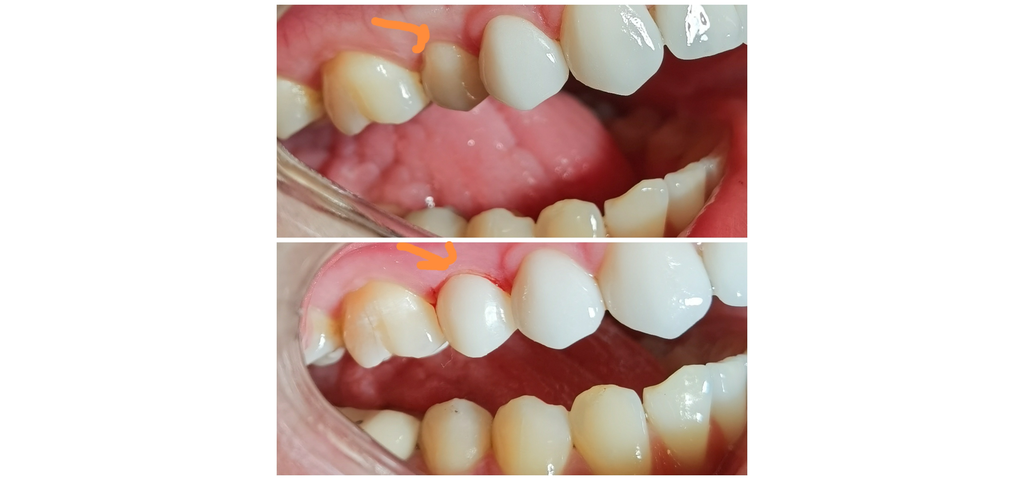
How a natural bonding result is designed
A natural result depends on proportions, contour and light, not only on matching a shade tab. Front teeth contain areas of different opacity and translucency. Their surfaces have subtle texture, and their line angles control how wide or narrow they appear. The edge shape influences age, character and the way teeth show during speech.
Composite can be layered using dentine-like and enamel-like shades or placed with a simplified material strategy when the defect permits. More layers do not automatically produce a better result. Material thickness, underlying tooth colour and the position of the restoration affect the final shade. The dentist also evaluates the restoration after finishing and polishing because surface texture changes how light reflects.
Gap closure requires more than filling empty space. The added width should be distributed so teeth remain proportionate, the midline is respected and the contact area supports gum health. If composite is overcontoured near the gum or between teeth, cleaning can become difficult. When a black triangle reflects loss of gum tissue rather than a simple tooth gap, the achievable correction and periodontal limitations should be discussed.
Lengthening teeth requires functional planning. The new edges are assessed during forward and side-to-side jaw movements, not only when the patient bites straight down. Speech sounds and lip movement can help evaluate edge position. A design that looks attractive in a still photograph may be uncomfortable or vulnerable if it interferes with the bite.
What happens during composite bonding?
1. Consultation and diagnosis
Dt. Özlem Özcan asks what the patient wants to change and examines the teeth, gums, existing restorations and bite. Clinical photographs, scans or impressions can support planning when several teeth are involved. Decay, trauma, sensitivity, tooth wear and discolouration are investigated rather than covered without diagnosis.
2. Health and colour planning
Active gum inflammation or decay is treated first. If whitening is appropriate, it is generally discussed before definitive bonding because composite does not whiten after placement. Time may be needed for the natural tooth shade to stabilise before the final composite colour is chosen.
3. Preview or design
Small repairs may be planned directly, while multi-tooth changes can benefit from photographs, a diagnostic design or a mock-up. These tools help evaluate proportions and confirm whether the intended addition is realistic. A preview does not replace evaluation of the actual bonded contours and bite.
4. Isolation and adhesive treatment
The teeth are cleaned and isolated from saliva and moisture. The surface is conditioned and the adhesive is applied according to the selected system. Reliable isolation is important because contamination can reduce bond quality. Local anaesthesia may not be needed for a purely additive procedure, but it can be used when decay removal, sensitivity or other treatment requires it.
5. Composite placement and shaping
Composite is added in controlled increments and hardened with a curing light. The dentist creates the required form, contacts, edge anatomy and colour transitions. Matrix systems or guides may help define shape. The objective is to add only what the design requires and preserve cleanable contours.
6. Finishing, polishing and bite assessment
Excess material is removed and margins are refined. Sequential finishing and polishing develop surface smoothness and gloss. Contact points and floss access are checked. The bite is evaluated in several movements, and the patient is asked to report any new high spot or interference after the appointment.
7. Review and future maintenance
A review can assess comfort, gum response, colour integration and function after the patient has used the restorations. Polishing can refresh the surface, and limited damage may be repaired by adding composite. The need for review is part of the treatment, not evidence that the original procedure failed.
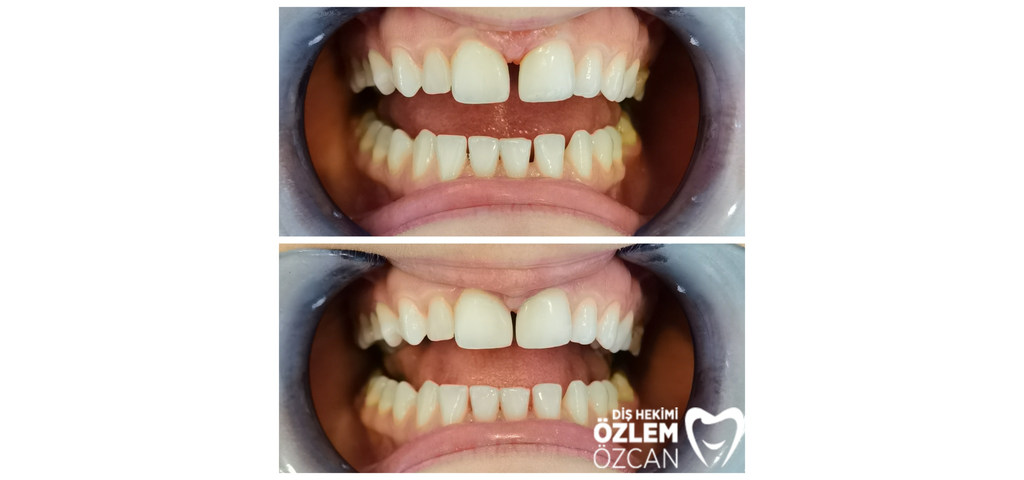
Can bonding close gaps or make teeth look straighter?
Bonding can close selected spaces by adding width to one or more teeth. It works best when the resulting proportions remain natural and the new contact area is cleanable. Larger spaces may need distribution across several teeth or orthodontic movement. If a gap is related to a frenum, missing tooth, periodontal tissue loss or tongue habit, the cause and likelihood of reopening should be considered.
Composite can visually soften mild rotations or asymmetries by adding material to certain surfaces. It cannot reposition roots or reduce a tooth that is significantly outside the arch without preparation. Masking crowding with extra material can make teeth wider and more prominent. Orthodontics may provide a more conservative biological correction even though it takes longer.
A combined plan is sometimes useful: orthodontics creates space or improves alignment, whitening establishes the background colour, and bonding refines proportions or edges. Combining smaller interventions can preserve more enamel than using restorations alone to force a rapid transformation.
Composite bonding for worn and chipped teeth
A chipped tooth should be assessed for the depth of injury, sensitivity, crack extension and possible trauma to the pulp. A small uncomplicated chip can often be rebuilt with composite. If the original fragment is available and suitable, reattachment may be considered in some circumstances. Larger fractures may require additional restorative or root canal assessment.
Worn edges raise a different question: why did the tooth structure disappear? Grinding, an edge-to-edge bite, erosion from dietary or gastric acids, nail biting and loss of posterior support can contribute. Replacing length without understanding space and forces may lead to repeated chipping. A wear plan may involve several teeth, bite analysis, medical referral for suspected reflux or a protective appliance.
Composite can be useful in additive rehabilitation because it is repairable and can preserve remaining structure. However, extensive cases are more complex than aesthetic bonding of one edge. They require a coordinated plan for vertical space, function and follow-up. Patients should not assume that a quick “bonding package” is equivalent to full-mouth wear management.
How long does composite bonding last?
There is no single lifespan for all bonding. Research on anterior composite restorations reports variable outcomes because restorations differ in size, location, indication, technique, bite and follow-up. A small protected repair and a full composite veneer across several teeth do not carry the same maintenance burden. Fracture, staining, marginal discolouration, loss of gloss and changes in shape can lead to polishing, repair or replacement.
The repairability of composite is an important advantage. A limited chip does not always require removal of the entire restoration. New material can sometimes be bonded after appropriate surface treatment, preserving more of the previous work and tooth. Whether repair is appropriate depends on the defect, colour, underlying tooth and reason for failure.
Longevity is influenced by the amount and position of composite, enamel support, isolation, adhesive technique, material curing, finish, bite, grinding, diet, hygiene and habits. Promising a fixed number of years or describing bonding as permanent ignores these differences. The better question is what maintenance is likely for the proposed design and how easily it can be repaired.
Will composite bonding stain?
Composite is more susceptible to surface staining and loss of gloss than glazed ceramic. Coffee, tea, red wine, strongly coloured foods and tobacco can affect appearance, although the degree varies with material, surface polish and exposure. Plaque and roughness also make deposits more visible. Regular hygiene and professional polishing can help maintain the surface.
Whitening products do not predictably lighten existing composite. If natural teeth are whitened after bonding, the restorations can appear darker in comparison and may need repolishing or replacement to match. For patients who want a lighter overall shade, whitening is usually planned before final colour matching when clinically appropriate.
Stain at one margin should be assessed rather than simply polished repeatedly. It may be superficial, but it can also indicate a rough margin, adhesive deterioration or decay. A dentist can determine whether cleaning, repair or replacement is required.
Planning composite bonding in Istanbul from abroad
International patients can send clear photographs and describe their main concern before travelling. This helps identify whether bonding appears worth assessing, but it cannot confirm tooth health, bite or final treatment numbers. Recent radiographs are useful when there are large restorations, trauma, sensitivity or suspected decay. Medical conditions, medicines, allergies, grinding and previous cosmetic treatment should also be disclosed.
Bonding may require fewer laboratory stages than ceramic veneers because it is placed directly. That does not mean every multi-tooth case should be compressed into one long appointment. Time is needed for diagnosis, colour planning, isolation, detailed shaping, polishing and bite review. If whitening, gum care, orthodontics or decay treatment is required first, the overall plan will take longer.
Patients should allow review time before departure, particularly when several teeth are lengthened or the bite has changed. After returning home, routine examinations and professional cleaning continue with a local dentist. A rough margin, chip, persistent sensitivity or bite interference should be assessed rather than left until the next trip to Turkey.
Information to share before your Istanbul appointment
- Full-face photographs at rest and smiling, plus close-up views of the relevant teeth
- A description of the exact chip, gap, colour or proportion concern
- Recent radiographs and previous treatment records where relevant
- Any history of dental trauma, grinding, clenching or repeated chipping
- Medical conditions, medicines, allergies and nicotine use
- Whether whitening or orthodontic treatment has recently been completed or is planned
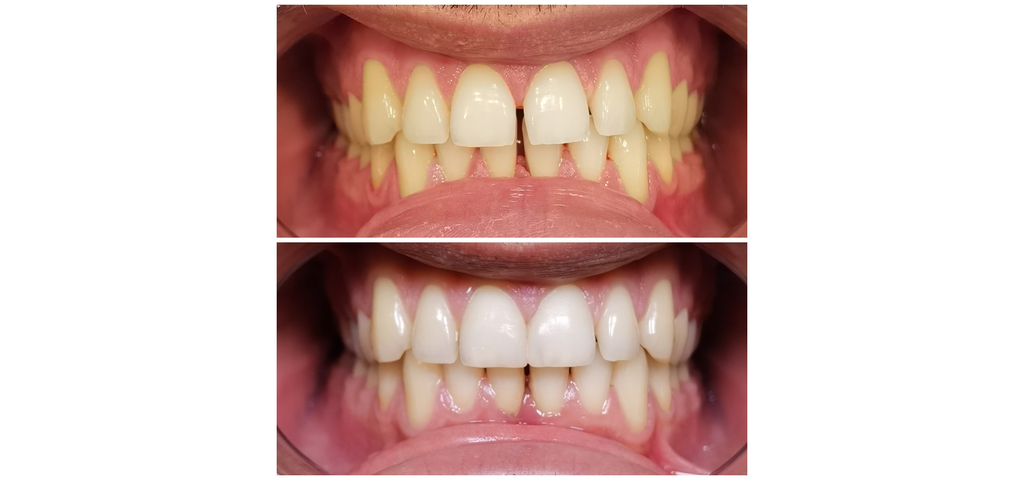
Risks and limitations
Composite bonding can chip, fracture, wear, discolour or detach. Margins can become visible and surface gloss can reduce. Temporary sensitivity or gum irritation may occur, particularly when treatment also involves decay removal or margins extend near the gum. A restoration can trap plaque if contours or contacts are poor, and the underlying tooth remains vulnerable to decay.
Colour matching has limitations. Composite placed on one front tooth must blend under different types of light, and the natural tooth can change over time. A very dark substrate may show through thin material, while increasing opacity can make the result less lifelike. Large changes may require more material than the bite or tooth position can safely accommodate.
Repairs are possible but not invisible in every case. Repeated additions can change texture and colour, and a larger failure may indicate that the treatment choice or bite needs reassessment. If most of a tooth is restored or structural damage progresses, an indirect restoration may eventually become more appropriate. Informed consent should include this possible treatment pathway without assuming it will occur.
How to care for bonded teeth
Brush twice daily with fluoride toothpaste and clean between the teeth every day. Floss should pass through contacts without shredding or catching. Avoid highly abrasive polishing products and do not attempt to reshape composite at home. Professional cleaning instruments and techniques should respect restoration surfaces.
Do not use bonded teeth to bite nails, pens, ice, hard shells or packaging. Cut very hard foods rather than placing unnecessary force on lengthened front edges. If a protective night guard is recommended, use it as instructed and bring it to dental reviews so its fit can be checked.
Attend routine examinations and request assessment when a restoration feels rough, moves, chips, traps food or changes the bite. Polishing at appropriate intervals can restore smoothness and gloss, but the need depends on the individual restoration and habits. Maintenance should aim to preserve both composite and natural enamel rather than replacing all bonding on a fixed schedule.
Frequently asked questions
Is composite bonding the same as a composite veneer?
Not always. Bonding may describe a small addition to one edge or surface, while a direct composite veneer covers most of the visible front surface. Both use resin-based composite, but the amount of material, colour control and maintenance needs can differ.
Can bonding be done without drilling?
Many additive cases need no removal of healthy enamel, but old fillings, decay, unsupported enamel or prominent tooth contours may require adjustment. The dentist should explain which surfaces, if any, will be altered before treatment.
Can composite bonding close a gap?
It can close selected gaps when the added width produces natural proportions and cleanable contacts. Larger spaces, tooth-size discrepancies or gaps linked to gum loss or tooth position may require orthodontics or a combined plan.
Can bonding make crooked teeth look straight?
It can visually soften mild irregularities by changing contour, but it does not move roots. Masking moderate or severe crowding can create bulky teeth or require unnecessary reduction, so orthodontic treatment may be more appropriate.
Does composite bonding hurt?
Purely additive bonding may not require local anaesthesia because healthy tooth structure is not being cut. Anaesthesia can be needed when decay, sensitivity or other restorative treatment is involved. Temporary sensitivity is possible and persistent symptoms require assessment.
Does bonding stain more than porcelain veneers?
Yes, composite generally loses gloss and picks up surface staining more readily than glazed ceramic. Good polishing, hygiene and reduced exposure to tobacco and strongly coloured foods can help. Professional repolishing may refresh the surface.
Can composite bonding be whitened?
No. Whitening acts on natural tooth structure and does not lighten composite in the same way. When whitening is appropriate, it is usually completed before definitive bonding so the resin can be matched to the stabilised tooth shade.
How long does composite bonding last?
There is no fixed lifespan. The size and location of the restoration, bite, grinding, material, technique, hygiene, diet and habits all influence maintenance. Bonding may require polishing, repair or replacement over time.
Can chipped bonding be repaired?
Often, a limited chip can be repaired after the surface and cause are assessed. A large or repeated fracture may require redesign, bite management or a different restorative option. Repairability is one of composite’s practical advantages.
Can I fly after composite bonding?
Flying is not generally restricted after uncomplicated bonding. The practical issue is allowing enough time for the bite, speech, contacts and comfort to be reviewed before departure, especially when several teeth have been lengthened or reshaped.
Requesting a composite bonding consultation in Istanbul
If you are considering composite bonding in Istanbul, contact Dt. Özlem Özcan’s clinic with clear photographs, a description of the change you want and any relevant radiographs or treatment history. An initial review can help prepare the appointment, but the final number of teeth, material approach, colour sequence and suitability are confirmed after clinical examination and bite assessment.
Good bonding should add only what the smile and tooth require. The consultation should clarify whether composite is the most conservative predictable option, what maintenance is likely and when orthodontics, whitening or ceramic treatment would provide a better balance.