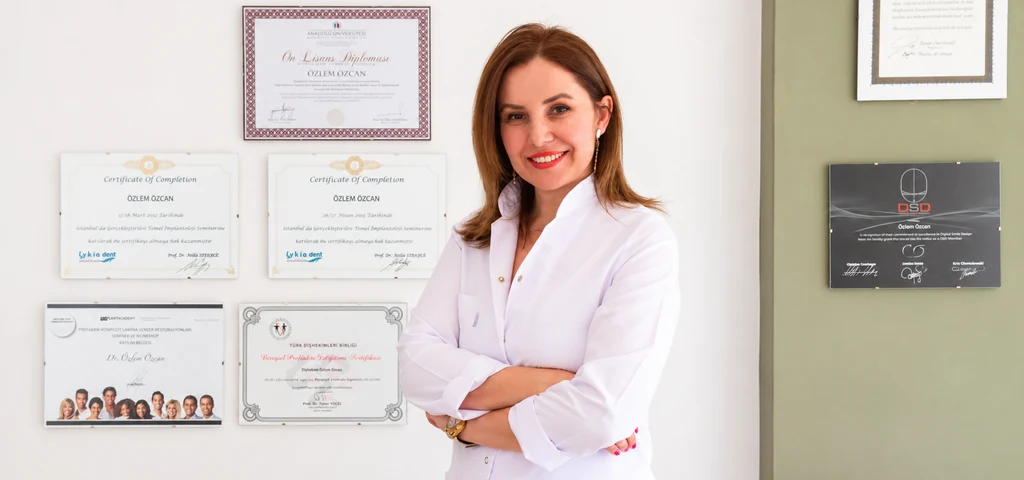


Aesthetic Dentistry in Turkey
Aesthetic dentistry is not one treatment and it should not begin with choosing a material from a photograph. It is a personalised process for improving the colour, shape, proportion or visible alignment of teeth while protecting oral health and as much natural tooth structure as reasonably possible. At her dental clinic in Istanbul, Dt. Özlem Özcan plans treatment after examining the teeth, gums, bite and the patient’s priorities. The appropriate plan may involve professional whitening, composite bonding, laminate veneers, crowns, gum care or a carefully sequenced combination; some people need only a small change, while others benefit from a broader smile design.
A personalised plan based on your teeth, gums, bite and priorities
For patients considering aesthetic dentistry in Turkey, the most important question is not “Which package should I buy?” but “What is the least invasive treatment that can predictably address my concern?” This page explains how that decision is made, where the main options differ, what an international patient should prepare before travelling to Istanbul and which limitations deserve honest discussion before treatment begins.

What does aesthetic dentistry include?
Aesthetic dentistry, often called cosmetic dentistry, refers to dental care intended to improve the appearance of the smile. Good aesthetic care is still dentistry: the result must be compatible with healthy gums, stable teeth, comfortable function and a maintainable bite. A visually attractive restoration is not a successful result if it traps plaque, irritates the gums, fractures under the patient’s bite or requires unnecessary removal of healthy enamel.
The scope can be very small. One chipped edge may be repaired with composite bonding. Surface staining may respond to whitening. A tooth whose colour, position or proportions cannot be corrected conservatively may be considered for a ceramic veneer. A badly weakened or heavily restored tooth may require a crown for structural reasons as well as appearance. When several concerns occur together, smile design helps organise these decisions across the visible teeth, but it does not mean that every tooth must receive the same restoration.
The word “aesthetic” also does not mean that every irregularity needs treatment. Natural smiles contain variations in translucency, texture, tooth length and symmetry. The aim is to decide which features genuinely concern the patient and which characteristics help the final result look like teeth rather than a uniform row of restorations.
Which concerns can an aesthetic dental plan address?
Depending on their cause and severity, aesthetic treatments may help with discolouration, small chips, worn edges, uneven tooth shape, gaps, differences in tooth size, older visible restorations or a smile that appears unbalanced. They may also improve the appearance of mild positional irregularities in selected cases. However, an aesthetic restoration does not move roots through bone, treat active gum disease or eliminate the biological cause of tooth wear. These distinctions matter because two people who dislike a similar-looking feature may require completely different treatment.
For example, a dark tooth may need vitality testing and an investigation of previous trauma rather than immediate coverage. Short teeth may be caused by wear, gum position, tooth proportions or a combination. Crowding may be better treated with orthodontics than by reshaping sound teeth. A gap may be closed with bonding, veneers or orthodontics, but the most suitable choice depends on the size of the space, tooth proportions, bite and long-term maintenance. Diagnosis turns an appearance-based request into a safe clinical plan.
How the main aesthetic treatments differ
| Treatment | Often considered for | Key advantage | Important limitation |
|---|---|---|---|
| Professional teeth whitening | Natural teeth that have become darker or stained | Changes colour without covering the tooth | Does not whiten crowns, veneers or fillings and cannot correct shape |
| Composite bonding | Small chips, edge changes, limited gaps and minor shape corrections | Usually additive and repairable | Can stain, wear or chip and may need maintenance |
| Laminate veneers | Selected visible teeth with colour, shape or proportion concerns | Can provide controlled colour and form with less coverage than a crown | Usually involves irreversible treatment and is not appropriate for every bite or tooth |
| Dental crowns | Teeth that are heavily filled, fractured, root-treated, severely worn or structurally compromised | Covers and restores the whole prepared tooth | Requires more tooth preparation than a veneer and should not be chosen for healthy teeth merely as a shortcut |
| Orthodontic treatment | Crowding, spacing and tooth-position problems | Moves teeth rather than masking their position | Requires time, monitoring and retention after treatment |
| Gum treatment or contour assessment | Inflammation, uneven gum margins or excess gum display in selected cases | Addresses the soft-tissue frame of the smile | The cause, periodontal health and biological width must be assessed before any procedure |
This comparison is a starting point, not a diagnosis. Treatments also interact. Whitening is often considered before colour-matched bonding or ceramic work because restorations do not bleach after they are made. Orthodontics may reduce or eliminate the need to remove tooth structure for a restorative correction. Gum health may need to stabilise before final impressions or scans. A careful sequence can be more important than the number of procedures.
Patients who want more detail can read the dedicated guides to professional teeth whitening in Istanbul, composite teeth bonding, laminate veneers and dental crowns. Each option has its own indications, maintenance needs and alternatives.
The consultation: how a treatment choice is made
An aesthetic consultation should connect what the patient sees with what the dentist can diagnose. Dt. Özlem Özcan first listens to the specific concern: colour, tooth display, shape, a single asymmetry or a more general dissatisfaction with the smile. It helps when patients describe what bothers them in their own words rather than requesting a fixed number of veneers or a preselected shade. Reference photographs can communicate preferences, but another person’s tooth shape cannot simply be copied onto a different face, bite and dental anatomy.
The clinical examination assesses teeth, existing restorations, decay risk, gum condition, visible smile line and bite. Records may include clinical photographs, radiographs when indicated, impressions or digital scans. Further tests can be required when there is pain, a history of trauma, tooth wear, jaw symptoms or uncertainty about a tooth’s health. No photograph sent online can replace these steps. A remote review can help organise a visit, but the plan remains provisional until an in-person examination and appropriate diagnostic records are complete.
The final recommendation should explain which teeth actually need treatment, why a particular option is suggested, what alternatives exist and what would happen if no elective aesthetic treatment were performed. It should also distinguish a restoration chosen for structural protection from one chosen mainly to change appearance. Patients should understand whether enamel will be removed, whether the procedure is reversible, how provisional restorations may be used and what maintenance is likely over time.

Why conservative planning matters
Dental enamel does not grow back after it is removed. That is why the sequence of options often starts with health and then considers the least invasive predictable method. “No-prep” or “minimal-prep” language should never be treated as a promise made before examining the teeth. An additive restoration may be possible when there is enough space and the desired change is compatible with the existing tooth position. In other cases, placing material without appropriate preparation could create bulky contours, affect the bite or make cleaning more difficult.
Veneers and crowns also serve different purposes. A veneer covers primarily the front surface and usually requires less tooth reduction than a crown. A crown surrounds the prepared tooth and can be appropriate when substantial tooth structure has already been lost or weakened. Using crowns on relatively intact teeth solely to create a rapid visual transformation can sacrifice more tissue than necessary. Equally, trying to use a thin veneer where a tooth needs full structural protection may be the wrong compromise. The condition of each tooth should lead the choice.
Conservative care does not always mean the treatment with the lowest initial intervention. It means balancing tissue preservation, predictability, function, maintenance and the patient’s priorities. In some cases, months of orthodontic movement can preserve sound teeth. In another case, repairing a small defect with composite may be more proportionate. When a damaged tooth genuinely requires coverage, a well-planned crown may be more responsible than repeated short-term repairs.
Designing a natural-looking smile
A natural result comes from relationships rather than from choosing the brightest shade. Tooth width and length, edge position, surface texture, translucency, gum levels, lip movement and the amount of tooth shown at rest all influence how a smile is perceived. The visible teeth should also relate to the face and to one another. If every tooth has identical opacity, length and anatomy, the result can appear artificial even when the laboratory work is technically precise.
Colour planning includes value, chroma, translucency and the way light moves through or reflects from a material. A very opaque restoration may help mask a dark underlying tooth but may require different planning from a translucent veneer bonded mostly to enamel. Existing crowns, fillings and neighbouring natural teeth add further constraints. The goal is not automatically to reach the lightest shade; it is to agree on a shade and material strategy that meets the patient’s preferences without losing coherence.
Where appropriate, a diagnostic design, mock-up or provisional stage can help evaluate length, shape and speech before the definitive result. These tools are communication aids, not guarantees that remove all clinical uncertainty. The mouth is dynamic, and the final design must accommodate biting forces, jaw movement, hygiene and biological limits as well as the approved appearance.
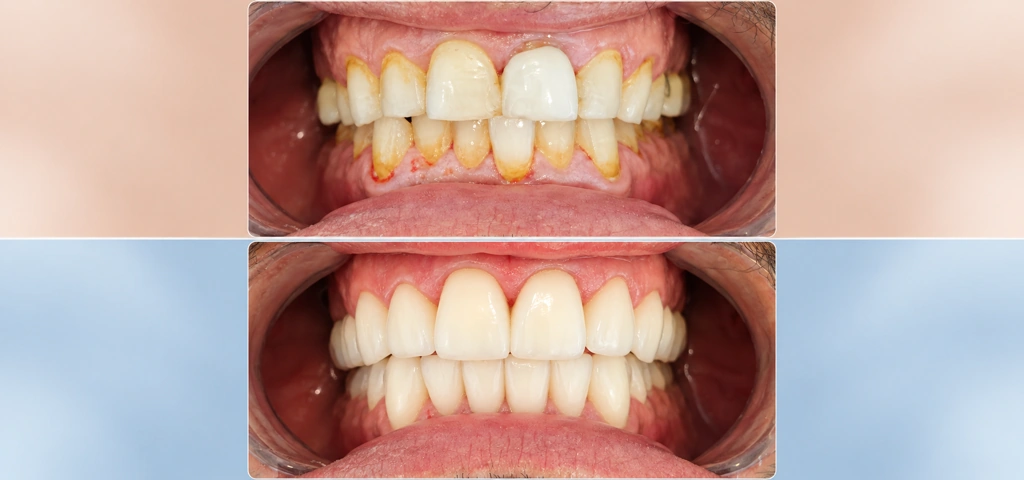
Oral health comes before elective aesthetic work
Bleeding gums, untreated decay, infection, unstable teeth and uncontrolled grinding can compromise an aesthetic result. Treating the visible surface without addressing these conditions may hide a problem temporarily while making later care more complex. Gum inflammation can also change the appearance of margins and reduce the accuracy of records. For this reason, hygiene care, periodontal treatment, decay management or stabilisation of damaged teeth may precede definitive aesthetic procedures.
Tooth wear deserves particular attention. It may relate to grinding, erosion from dietary or gastric acids, an unfavourable bite or several factors together. Simply replacing lost length without understanding the available space and the continuing cause can increase the risk of chipping or fracture. Patients who clench or grind may need a design adapted to their bite and may be advised to use a protective appliance after treatment. A night guard reduces some mechanical risk but cannot make restorations indestructible.
Planning aesthetic dentistry in Istanbul as an international patient
Travelling for dental care adds practical decisions to the clinical ones. Before booking flights around a promised completion date, patients should share relevant dental records, medical conditions, medicines, allergies, pregnancy status and any history of complications. Clear, recent photographs and available radiographs can assist an initial conversation. They cannot confirm that a tooth is healthy, measure the bite accurately or reveal every condition, so travel plans should allow for the possibility that the in-person diagnosis changes the preliminary proposal.
The number and spacing of appointments depend on the treatment. Whitening, bonding, ceramic restorations, gum care and orthodontics follow different schedules. Laboratory-made veneers or crowns involve stages such as preparation where indicated, records, provisional restorations, laboratory production, evaluation and final bonding or cementation. Additional treatment may be needed if examination identifies decay, gum disease, infection or a tooth that cannot be restored as initially expected. A responsible schedule includes time for assessment and review rather than treating every hour in Istanbul as a production deadline.
International patients should ask who performs each clinical stage, what material and restoration type are being proposed, how provisional restorations are managed, what aftercare information will be provided and whom to contact after returning home. They should also plan routine dental care in their country of residence. Travelling to Turkey for treatment does not remove the need for examinations, professional cleaning and timely attention to any future problem.
Information to send before your Istanbul appointment
- A clear description of the main concern and the change you hope to achieve
- Recent full-face, smile and close-up dental photographs taken in good light
- Available recent radiographs and relevant previous treatment records
- A complete list of medical conditions, medicines, allergies and tobacco or nicotine use
- Any history of tooth grinding, jaw discomfort, dental trauma or sensitivity
- The dates you can attend, without assuming that these dates determine the clinical plan
What can affect treatment time?
It is not clinically responsible to give every aesthetic case the same timetable. Treatment time can change with the number of teeth involved, the need for hygiene or gum treatment, the condition of old restorations, whether root canal or restorative care is required, laboratory stages, the use of provisional restorations and the need to review the bite. Orthodontic treatment follows a longer biological process and requires regular monitoring. Implant treatment, if missing teeth are part of the smile plan, may involve healing periods that cannot be compressed for travel convenience.
The fastest plan is not necessarily the most conservative or stable plan. Dt. Özlem Özcan discusses the anticipated stages after examination and explains which parts are confirmed and which depend on clinical findings. Patients arranging accommodation or return flights should leave reasonable flexibility and should not make non-refundable assumptions based only on a social-media message or a photograph-based estimate.
Risks, limits and future maintenance
All dental procedures have limitations. Depending on the treatment, possible concerns include temporary or persistent sensitivity, gum irritation, colour mismatch, chipping, fracture, debonding, wear, the need for repair or replacement and the possibility that a tooth later requires additional treatment. Tooth preparation is irreversible. A restoration can last for many years, but no veneer, filling or crown should be described as permanent for every patient.
Maintenance depends on material and risk factors. Composite can be polished and repaired but may change colour or texture. Ceramic resists staining better but can still chip or fracture and cannot be whitened after placement. Gum recession can expose a margin over time. Natural teeth remain vulnerable to decay around restoration edges, particularly when plaque control or diet is unfavourable. Grinding, nail biting, using teeth to open objects and chewing very hard items place additional load on restorations.
Aftercare normally includes daily brushing with fluoride toothpaste, cleaning between teeth, regular dental examinations and professional hygiene at an interval based on individual risk. Any recommended retainer or protective appliance should be used as instructed. Pain, a change in the bite, movement, swelling, a loose restoration or a fracture should be assessed rather than left until the next planned trip.
Who may be suitable for aesthetic dental treatment?
Potential candidates are adults with a specific appearance-related concern, realistic expectations and oral conditions that can be made stable. Suitability is treatment-specific: a person may be appropriate for whitening but not veneers, or for orthodontics before any restorative work. Healthy enamel availability, existing restorations, tooth position, gum health, bite, decay risk and habits all influence the recommendation.
Treatment may need to be delayed or modified when there is active gum disease, uncontrolled decay, untreated infection, insufficient diagnostic information, unrealistic expectations or a medical issue that requires coordination. Heavy grinding and severe tooth wear do not automatically prevent treatment, but they change the risk assessment and design. Young patients require particular caution because teeth, gums and expectations may still be changing, and irreversible elective treatment needs strong justification.
Why clinician-led planning matters more than a package name
Terms such as “smile makeover” or “Hollywood Smile” describe an aim or a group of procedures; they do not identify what a patient clinically needs. A fixed package may assume the same number of teeth, material and timetable for people with very different mouths. Clinician-led planning begins with diagnosis, then selects the smallest appropriate combination of treatments. It also allows a patient to decline an elective step after understanding its benefits, limitations and alternatives.
Dt. Özlem Özcan’s role is to translate a visual goal into tooth-by-tooth decisions that the patient can understand. The discussion should be specific: which tooth is being changed, which surface is involved, whether preparation is anticipated, why that material is being considered and what maintenance follows. This is more useful than relying on labels such as “premium,” “perfect” or “full smile,” which do not communicate biological cost or clinical suitability.
Questions worth asking before you decide
- What is causing the colour, shape, wear or alignment concern?
- Can the goal be reached with whitening, bonding or orthodontics before considering ceramic coverage?
- Which teeth need treatment and which teeth can remain untouched?
- Will enamel be removed, and is the procedure reversible?
- Why is a veneer, crown or composite restoration recommended for this particular tooth?
- How will the proposed design affect cleaning, speech and the bite?
- What are the realistic risks, alternatives and maintenance needs?
- What happens if the in-person examination differs from the remote assessment?
- How will aftercare be coordinated after returning home?
A clear consultation should leave room for these questions. An elective treatment decision should not depend on time pressure, a discount deadline or a promise that complications are impossible.
Frequently asked questions
Is aesthetic dentistry the same as cosmetic dentistry?
The terms are often used interchangeably. “Aesthetic dentistry” can place greater emphasis on a natural result integrated with oral health and function, but the label alone does not establish a different qualification or treatment standard. The proposed procedure, diagnosis, clinician and informed-consent process matter more than the wording.
Do I need veneers for a smile makeover?
No. A smile makeover is a planning concept, not a requirement to place veneers. Depending on the concern, it may involve whitening, bonding, orthodontics, replacement of an old restoration, gum care or no treatment at all. Veneers are considered only when their benefits and biological cost make sense for the individual teeth.
Can aesthetic dentistry look natural?
It can be planned to look natural by considering tooth proportions, texture, translucency, shade, gum levels, lip movement and the surrounding natural teeth. “Natural” is also a personal preference. Photographs and, where suitable, a mock-up or provisional stage can help patient and dentist communicate about the intended result.
Will all my teeth need to be treated?
Not necessarily. The number depends on the concern, smile display, condition of each tooth and ability to blend treated and untreated teeth. A conservative plan deliberately identifies teeth that can remain untouched. The number should follow the design and clinical findings rather than a standard package.
Can my treatment be planned from photographs before I travel to Turkey?
Photographs and existing records can support an initial discussion and help estimate which examinations may be needed. They cannot confirm the final plan. Tooth vitality, decay, gum health, bite, bone and the fit of existing restorations require in-person assessment and, where indicated, radiographs or other records.
Is aesthetic dental treatment painful?
The experience varies with the procedure and the individual. Some treatments involve no drilling; others require local anaesthesia and tooth preparation. Temporary sensitivity or gum tenderness can occur. The dentist should explain how comfort will be managed for the specific treatment rather than promising that every procedure is completely painless.
How white should I choose my teeth?
There is no universally correct shade. Skin tone, natural tooth colour, translucency, the number of teeth being treated and personal preference all influence the choice. A very bright shade may be an intentional preference, but it should be selected after understanding how it will relate to untreated teeth and how opacity may affect appearance.
How long do veneers, bonding or crowns last?
There is no single lifespan that applies to every restoration. Material, tooth support, bite, grinding, hygiene, diet, smoking, technique and maintenance all influence longevity. These treatments can require polishing, repair, rebonding or replacement over time, so planning should include future care as well as the initial result.
Can crowns or veneers be whitened later?
No. Whitening products act on natural tooth structure and do not lighten ceramic or composite restorations in the same way. If whitening is appropriate, it is commonly planned before final shade selection. Existing restorations may need replacement if they no longer match after natural teeth become lighter.
What should I do if I have a problem after returning home?
Contact the treating clinic promptly and provide clear information and photographs if requested. Pain, swelling, trauma, a loose restoration or a significant bite change may require local clinical assessment rather than remote advice alone. Before treatment, ask how records and aftercare information can be shared with your regular dentist.
Requesting an aesthetic dentistry consultation in Istanbul
If you are considering aesthetic dentistry in Istanbul, you can contact Dt. Özlem Özcan’s clinic with a concise description of your concern, clear photographs and any recent dental records you already have. The initial exchange can help identify the questions that need to be answered and prepare an appointment. Treatment recommendations, the number of teeth, material choices and timing are confirmed only after clinical examination and appropriate diagnostics.
Bring your goal, not a commitment to a package. The purpose of the consultation is to understand the condition of your teeth, compare reasonable options and decide whether treatment is appropriate for you.