


E-Max vs Zirconia Turkey

Veneers for Discoloration Istanbul
14 December 2025
Custom Smile Makeover Istanbul
14 December 2025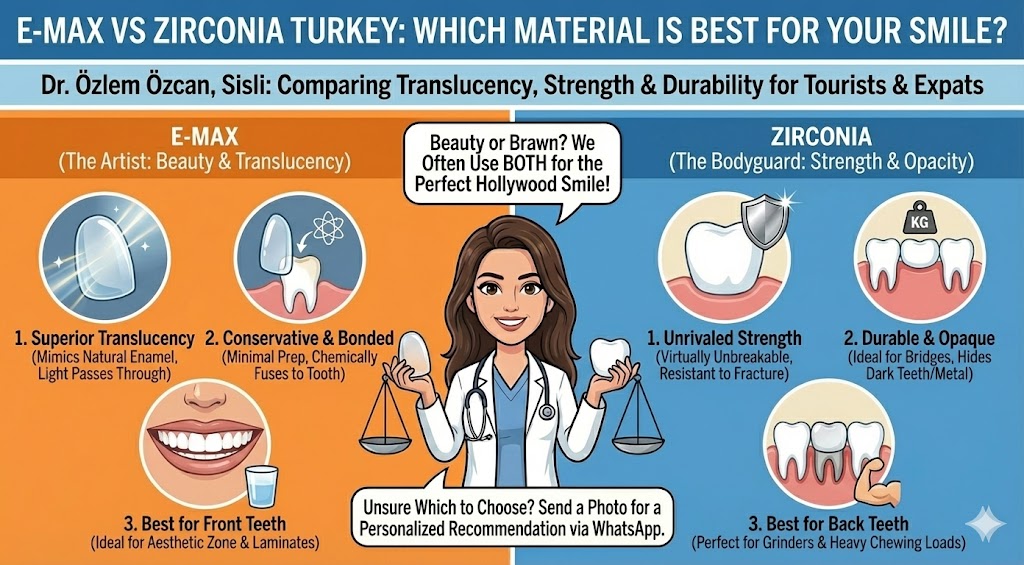
E-Max vs Zirconia Turkey: Which Material is Best for Your Smile?
You have decided to transform your smile. You have booked your ticket to Istanbul, the global capital of aesthetic dentistry. But now, you face a technical dilemma that leaves many patients scratching their heads. You hear the terms “E-Max” and “Zirconia” thrown around by clinics, often with conflicting advice. Some say E-Max is the most beautiful. Others say Zirconia is the strongest. You are left asking: “Which one should I choose?”
The truth is, in the debate of E-Max vs Zirconia Turkey, there is no single “winner.” There is only the right material for the right tooth. It is not about choosing one over the other; it is about understanding the unique properties of each material and how they interact with your bite, your gum health, and your aesthetic goals. In many of our most successful Hollywood Smile makeovers, we actually use both materials in the same mouth to achieve the perfect balance of beauty and brawn.
In this comprehensive, science-backed guide, Dt. Özlem Özcan, a leading aesthetic dental surgeon in Sisli, Istanbul, acts as your unbiased consultant. We will break down the chemistry, the costs, and the clinical indications for each. By the end of this article, you will be able to discuss your treatment plan with the confidence of a dental professional.
The Contenders: Defining the Materials
To make an informed decision on E-Max vs Zirconia Turkey, we first need to understand what these materials actually are.
What is E-Max? (The Artist)
E-Max is a brand name (by Ivoclar Vivadent) for a material called Lithium Disilicate. It is a type of glass-ceramic. Because it is glass-based, it has incredible optical properties. It mimics the translucency of natural tooth enamel better than any other material in dentistry.
Key Feature: It allows light to pass through it, creating a “vital” look. It is bonded (fused) to the tooth, making it part of the tooth structure.
What is Zirconia? (The Bodyguard)
Zirconia is made from Zirconium Dioxide, a white, crystalline oxide of zirconium. Although it is a ceramic, it shares many properties with metal (like Titanium) in terms of strength. In fact, it is often called “Ceramic Steel.”
Key Feature: It is incredibly tough and resistant to fracture. It is opaque enough to hide dark underlying teeth but has evolved to become much more aesthetic in recent years.
Round 1: Aesthetics (Translucency)
When comparing E-Max vs Zirconia Turkey for the “Smile Zone” (the front 6-8 teeth), aesthetics is usually the priority.
E-Max: The Clear Winner
If your goal is a smile that looks 100% natural, indistinguishable from real teeth, E-Max is the gold standard.
Its high translucency allows the color of the underlying tooth (if healthy) to influence the final shade, creating a depth that looks alive. It is the material of choice for Porcelain Laminates and veneers where we want the most delicate, glass-like finish. The edges can be crafted to be slightly transparent, just like a youthful natural tooth.
Zirconia: The Improver
Standard Zirconia is opaque (white and chalky). It reflects light rather than absorbing it, which can sometimes look “flat” or “fake” on front teeth.
However, modern “High Translucency” (HT) Zirconia has improved significantly. While it still doesn’t match E-Max for pure beauty, it is now aesthetically pleasing enough for crowns, especially when layered with porcelain.
Round 2: Strength and Durability
This is where the tables turn in the E-Max vs Zirconia Turkey comparison.
Zirconia: Unbreakable
Zirconia is a beast. It has a flexural strength of 900 to 1200 MPa (Megapascals).
This makes it virtually impossible for a human to break with natural chewing forces. It is the ideal material for:
- Back Teeth (Molars): Which take the heavy load of chewing.
- Bruxism (Grinders): Patients who grind their teeth at night destroys E-Max, but Zirconia can withstand the pressure.
- Dental Bridges: If you are missing a tooth, Zirconia is strong enough to span the gap. E-Max is generally too brittle for long bridges.
E-Max: Strong but Delicate
E-Max has a strength of about 360 to 400 MPa. This is 3 times stronger than natural tooth enamel (which is about 120 MPa), so it is plenty strong for front teeth. However, if used on a back molar in a patient who grinds, it may crack over time.
Round 3: Invasiveness (Preparation)
How much of your natural tooth needs to be cut? This is a critical factor for patients interested in Minimal Prep Veneers.
E-Max: Conservative
E-Max can be made incredibly thin (0.3mm to 0.5mm) and still be handled safely. Because it is bonded chemically to the enamel, it restores the strength of the tooth. This allows for minimal preparation, preserving your natural structure.
Zirconia: Requires More Space
Zirconia generally requires a minimum thickness of 0.8mm to 1.5mm to ensure it doesn’t crack the ceramic layering (if used) and to provide structural integrity. Also, Zirconia is usually cemented (glued) rather than bonded. This means the tooth shape must be cut more aggressively (retentive form) to keep the crown in place mechanically.
The Decision Matrix: Which One Do You Need?
At Dt. Özlem Özcan’s clinic, we don’t guess. We use this clinical matrix to decide between E-Max vs Zirconia Turkey for your specific case:
Scenario A: The Front Makeover
Goal: Perfect aesthetics on the front 8 teeth.
Condition: Teeth are healthy, not heavily filled.
Verdict: E-Max Laminate Veneers.
Why? Maximum beauty, minimum drilling.
Scenario B: The Heavy Grinder
Goal: A white smile that won’t break.
Condition: Patient grinds teeth at night (Bruxism).
Verdict: Zirconia Crowns (Monolithic).
Why? E-Max would chip under the pressure. Zirconia will last a lifetime.
Scenario C: The Dark Tooth
Goal: Hide a grey tooth (Tetracycline stain or dead nerve).
Condition: One or more teeth are severely discolored.
Verdict: Zirconia.
Why? E-Max is translucent; the grey would show through. Zirconia is opaque; it masks the darkness perfectly.
Scenario D: The Missing Tooth
Goal: Replace a missing tooth with a bridge.
Verdict: Dental Bridge made of Zirconia.
Why? E-Max connectors can snap under the load of a bridge. Zirconia acts like steel.
The Hybrid Approach: Mixing Materials
This is a secret of high-end cosmetic dentistry. You do not have to choose just one.
We often perform a “Combo Treatment”:
We place E-Max Veneers on the front 6 teeth (canine to canine) for that glass-like translucency.
Then, we place Zirconia Crowns on the premolars and molars for strength.
The Trick: Our master ceramist layers the porcelain on the Zirconia to match the shade and texture of the E-Max exactly. No one can tell the difference, but your mouth gets the best of both worlds in the E-Max vs Zirconia Turkey equation.
Cost Comparison: What is the Price Difference?
Budget is always a factor. In general, E-Max vs Zirconia Turkey prices are relatively close, but E-Max is slightly more premium.
Why is E-Max more expensive?
The cost of the raw material (Ivoclar ingots) is higher. Furthermore, the labor involved is more intensive. E-Max veneers are often hand-layered or pressed and then stained by an artist. It takes more time to create a perfect E-Max veneer than a milled Zirconia crown.
The Istanbul Advantage:
Regardless of which you choose, the cost in Turkey is 50% to 70% lower than in the UK, USA, or Europe.
You can get premium E-Max veneers here for the price of standard metal-porcelain crowns back home. We never use cheap generic brands; we use certified materials, providing you with a certificate of authenticity.
The Monolithic Trend: Full Zirconia
Recently, a new player has entered the E-Max vs Zirconia Turkey debate: Monolithic Zirconia.
Traditionally, Zirconia was just a core (cap) covered in porcelain. Sometimes, the porcelain would chip off the core.
Monolithic Zirconia is a solid block of Zirconia, shaped and painted. There is no porcelain to chip. It is virtually indestructible. We use this frequently for implant crowns and back molars. While less translucent than E-Max, modern “Multi-Layer” Monolithic Zirconia has a gradient of color that looks surprisingly natural.
Integration with Implants
If you are having Dental Implants, the crown that goes on top is usually Zirconia.
Why? The metal screw of the implant is grey. Zirconia’s opacity hides this metal shadow. If we put an E-Max crown on a titanium implant, the tooth might look greyish. However, for the highest aesthetics on front implants, we can use a Zirconia abutment (white post) with an E-Max crown on top.
Why Choose Dt. Özlem Özcan in Sisli?
The material is only as good as the doctor who prescribes it and the technician who crafts it.
In the debate of E-Max vs Zirconia Turkey, Dt. Özlem Özcan offers:
- Unbiased Advice: We don’t push the most expensive option; we push the medically correct one.
- Master Ceramists: Our lab partners are artists who can make Zirconia look like E-Max and E-Max look like nature.
- Transparency: We explain exactly what goes into your mouth. You will know the brand, the shade, and the reason for every choice.
Frequently Asked Questions (FAQ)
Does E-Max stain over time?
No. E-Max is a high-grade glass ceramic. It is non-porous and highly resistant to staining from coffee, tea, or wine. It maintains its gloss and color for 15-20 years with proper hygiene.
Is Zirconia metal or ceramic?
Zirconia is a metal-free ceramic. It is chemically a crystal oxide of zirconium. It is biocompatible and hypoallergenic, making it perfect for patients with metal allergies.
Can I whiten Zirconia or E-Max crowns?
No. Unlike natural teeth, ceramic materials do not respond to bleaching gels. If you want a whiter smile, you must perform Teeth Whitening on your natural teeth before we match the color of your new crowns or veneers.
Which lasts longer: E-Max or Zirconia?
In terms of raw durability against breakage, Zirconia lasts longer. However, E-Max has better bond strength to the tooth enamel. If cared for properly (and if you don’t grind your teeth), both can last 15 to 20 years.
Conclusion: The Verdict
So, who wins the battle of E-Max vs Zirconia Turkey?
E-Max wins the beauty pageant. It is the queen of the front teeth.
Zirconia wins the weightlifting contest. It is the king of the back teeth and bridges.
The best smile often uses both. At Dt. Özlem Özcan’s clinic in Sisli, we master both materials to give you a smile that is not only stunningly beautiful but built to withstand the test of time.
Still unsure which is right for you? Send us a photo of your smile via WhatsApp, and Dr. Özlem will recommend the ideal material for your case.
For location details and to book your consultation, please visit our Contact Page.


