


Translucent Veneers Turkey

Veneers Before & After Istanbul
14 December 2025
Smile Transformation Istanbul
14 December 2025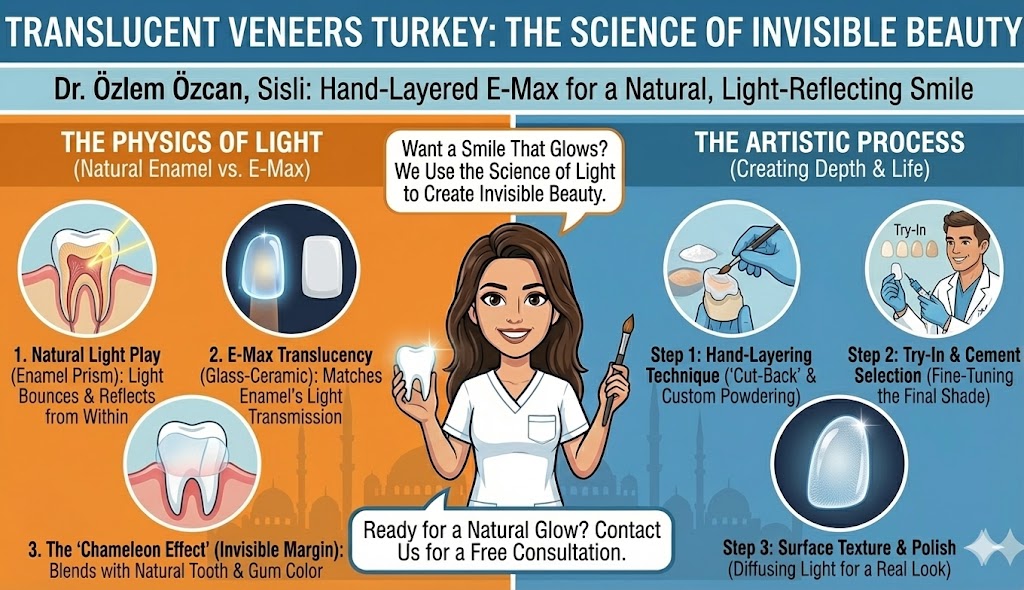
Translucent Veneers Turkey: The Science of Invisible Beauty
Imagine holding a pearl up to the sunlight. It doesn’t just block the light; it captures it. The light seems to enter the surface, bounce around inside, and glow from within. Now, imagine a piece of white plastic held up to the same light. It looks flat, dead, and one-dimensional. This analogy perfectly describes the difference between average dental crowns and high-end Translucent Veneers Turkey.
For years, the trend in cosmetic dentistry was “White at all costs.” Patients wanted smiles that popped, often resulting in the infamous “piano key” look—teeth that were perfectly straight, incredibly white, but completely opaque. They looked like veneers. Today, the pendulum has swung. The modern sophisticated patient demands something far more difficult to achieve: a smile that is perfect, yet indistinguishable from nature. They want the brightness of youth without the artificiality of a prosthetic.
If you are looking for Translucent Veneers Turkey, you are looking for the pinnacle of dental artistry. You are seeking a restoration that mimics the complex optical properties of natural tooth enamel. In this detailed guide, Dt. Özlem Özcan, a master of aesthetic dentistry in Sisli, Istanbul, invites you into the world of light, layers, and glass-ceramics. We will explore how we manipulate transparency to create smiles that look alive.
The Physics of a Natural Smile
To understand why Translucent Veneers Turkey are the gold standard, we must first understand the anatomy of a natural tooth. A tooth is not a solid block of color. It is a complex structure composed of two main optical layers.
1. Dentin (The Body)
The inner layer, called dentin, provides the color of the tooth. It is opaque and usually ranges from yellow to brown. It stops light from passing through.
2. Enamel (The Prism)
The outer layer, according to Wikipedia, is the hardest substance in the human body and is semi-translucent. It acts like a fiber-optic cable. It allows light to pass through it, hit the dentin, and reflect back.
The “Halo” Effect: At the very biting edge of the tooth (the incisal edge), there is no dentin underneath—only pure enamel. This creates a beautiful phenomenon where the tip of the tooth looks slightly blueish-grey or transparent. This “Halo Effect” is the hallmark of a young, healthy tooth.
When we create Translucent Veneers Turkey, our goal is to replicate this interplay of light. If we use a material that is too opaque, we kill the light, and the tooth looks fake. If we use a material that is too transparent, the dark mouth shows through, and the tooth looks grey. Finding the perfect balance is the art.
What Are Translucent Veneers Made Of?
You cannot achieve true translucency with standard metal-porcelain or old-fashioned Zirconia. The material must be glass-based.
Lithium Disilicate (E-Max)
This is the secret weapon of Translucent Veneers Turkey. E-Max is a glass-ceramic material that has the same refractive index as natural enamel.
Why it works:
- Light Transmission: It allows light to pass through the veneer surface, giving it “depth.”
- Chameleon Effect: Because it is translucent, it picks up some of the warmth from the underlying natural tooth, blending seamlessly with your gum line.
- Strength: Despite being glass-like, it is incredibly strong (400 MPa) when bonded to enamel.
Feldspathic Porcelain
For the ultimate Translucent Veneers Turkey experience, we sometimes use Feldspathic porcelain. This is the oldest and most aesthetic ceramic. It is hand-painted layer by layer. It is weaker than E-Max but offers the highest level of optical beauty, often used for “No-Prep” veneers.
The Manufacturing Process: “Cut-Back” vs. “Monolithic”
Not all veneers in Turkey are created equal. There are two ways to make a veneer, and this distinction defines the quality of Translucent Veneers Turkey.
1. Monolithic (The Standard Way)
A machine mills the veneer from a single block of porcelain. The dentist then paints some color on the outside.
The Problem: The color is only on the surface. If you brush too hard, it can wear off. It lacks true depth.
2. The Cut-Back and Layering Technique (The Dr. Özlem Way)
This is “Haute Couture” dentistry.
Step A: We mill a thin core of E-Max.
Step B: The technician manually “cuts back” (removes) the porcelain at the biting edge.
Step C: The master ceramist hand-layers translucent powders (blue, grey, opal, pearl) into that cut-back area.
Step D: The veneer is fired in the oven.
The Result: The transparency is inside the veneer. It creates a 3D effect where the biting edge looks hyper-real. This is the essence of high-quality Translucent Veneers Turkey.
Who is the Ideal Candidate?
While everyone wants translucent veneers, not everyone can have them. Physics dictates suitability.
The Perfect Candidate
- Healthy Tooth Color: If your natural teeth are a normal shade (A1, A2, or A3), Translucent Veneers Turkey work beautifully. They act like a contact lens, brightening the tooth while letting the natural character shine through.
- Enamel Preservation: Because E-Max requires bonding, it works best on patients who have healthy enamel (Minimally Invasive cases).
The “Danger” Zone (Contraindications)
- Severe Discoloration: If you have very dark grey teeth (Tetracycline stains) or a black dead tooth, you CANNOT use highly translucent veneers.
Why? The dark color will show right through the glass veneer, making your new smile look grey.
The Solution: In these cases, we must use Veneers for Discoloration which have an opaque core to block the stain, layered with translucent porcelain on top.
Translucency vs. Brightness: The “Bleach” Dilemma
Patients often ask: “I want Translucent Veneers Turkey, but I also want them to be BL1 (Hollywood White). Is that possible?”
This is a challenging request.
The Conflict: Whiteness usually comes from opacity (think of white paint). Translucency is the absence of color (think of water).
The Compromise: We can achieve a “Natural Hollywood” look. We use a bright, white body porcelain (BL1 or BL2) for the main part of the tooth, but we keep the biting edge (the last 1-2mm) translucent.
This prevents the “Chiclet” look. The tooth looks white, but the transparent edge convinces the eye that it is natural enamel.
Why Choose Istanbul for Translucent Work?
Crafting translucency is the hardest skill in dental technology. It requires a ceramist with an artist’s eye.
The Istanbul Advantage:
Turkey has a long history of ceramic artistry. The dental technicians in Istanbul are world-renowned for their layering skills.
Cost vs. Quality:
In the UK or USA, a hand-layered translucent veneer costs $2,000+ because of the labor hours involved.
In Istanbul, you can access this same level of hand-craftsmanship for Translucent Veneers Turkey at a price 70% lower. You are not paying for the machine; you are paying for the artist, at a much more accessible rate.
The “Natural Look” Protocol
When you come to Dt. Özlem Özcan’s clinic in Sisli for Translucent Veneers Turkey, we follow a specific protocol to ensure natural beauty.
1. Photography and Color Mapping
We take macro photos of your existing teeth. We map the “polychromatic” nature of your smile. A natural tooth has amber tones near the gum, creamy white in the middle, and blue/grey transparency at the tip. We aim to replicate or enhance this map.
2. Surface Texture
Translucency is enhanced by texture. If a veneer is perfectly smooth, it reflects light like a bathroom mirror (glassy). We add microscopic horizontal grooves (perikymata) and vertical lobes. This diffuses the light, making the translucency appear softer and more natural.
3. The Try-In Paste
Before we glue the veneers permanently, we use “Try-In Gels.”
Since the veneers are translucent, the color of the glue matters!
If we use a “White” glue, the veneer looks brighter.
If we use a “Transparent” glue, the veneer looks deeper.
We test different glues in your mouth so you can choose the final shade of your Translucent Veneers Turkey.
Translucent Veneers vs. Zirconia
This is the most common comparison patients make.
| Feature | Translucent Veneers (E-Max) | Zirconia Crowns |
|---|---|---|
| Light Transmission | High (Mimics Enamel) | Low to Medium (More Opaque) |
| Best For | Natural Look, Front Teeth | Strength, Masking Dark Teeth, Bridges |
| Thickness | Ultra-Thin (0.3mm – 0.5mm) | Thicker (0.8mm – 1.5mm) |
| Aesthetics | 10/10 (Alive) | 8/10 (Clean but flatter) |
For patients seeking Translucent Veneers Turkey, E-Max is almost always the superior choice over Zirconia, unless grinding or missing teeth are involved.
Integration with “Pink Aesthetics”
Translucent veneers have a unique interaction with the gums.
Because light passes through the veneer into the root, the gum tissue illuminates naturally.
With old metal-porcelain crowns, the metal blocked the light, creating a “dark shadow” or grey line at the gum.
With Translucent Veneers Turkey, the gum stays pink and healthy-looking because the light transmission continues down the root, maintaining the “Contact Lens” effect.
Maintenance: Keeping the Shine
Translucent veneers are beautiful, but they require care to maintain their optical properties.
1. Polish: Over years, the surface glaze can wear slightly. A professional polish every 6 months keeps the light reflection sharp.
2. No Abrasives: Do not use charcoal or baking soda toothpaste. These scratch the glass surface. Scratches scatter light and make the veneer look matte and dull. Use non-abrasive gel toothpaste.
3. Night Guard: Translucent porcelain is strong but brittle (like a crystal glass). If you grind your teeth, you must wear a night guard to prevent the beautiful incisal edges from chipping.
Dt. Özlem Özcan’s Artistic Vision
Why choose Dt. Özlem Özcan for Translucent Veneers Turkey?
Because she understands that “Perfection is the enemy of Natural.”
A perfectly symmetrical, monochromatic white smile looks fake.
Dr. Özlem designs smiles with “Perfect Imperfections”—slight variations in translucency, subtle rotations, and textural depths that trick the human eye into believing the teeth are real. She is not just a dentist; she is an artist of light.
Frequently Asked Questions (FAQ)
Will my natural tooth show through the translucent veneer?
Yes, to a degree. This is intentional. The veneer blends with your natural tooth color to create a lifelike appearance. If your natural teeth are very yellow, we may slightly whiten them or use a slightly more opaque cement to balance the final color.
Are translucent veneers weaker than opaque ones?
Not necessarily. E-Max material has the same strength (400 MPa) regardless of its opacity. However, because translucent veneers are often made thinner (minimal prep), they rely heavily on the strength of the bond to the enamel.
Can I get translucent veneers if I have a root canal tooth?
Root canal teeth often turn dark grey. A highly translucent veneer would show this darkness. In this case, we might use a Zirconia crown (which is opaque) on the dark tooth and match the outer porcelain layering to the translucent veneers on the other teeth.
Do they stain?
No. High-quality E-Max porcelain is non-porous and does not stain. However, the bonding cement at the microscopic edge can stain if you smoke heavily or drink excessive coffee without rinsing. Good hygiene prevents this.
Conclusion: Let the Light In
A smile is not just a white strip; it is a jewel that reflects your personality. Translucent Veneers Turkey offer the most sophisticated, high-end solution for patients who value natural beauty above all else.
Dt. Özlem Özcan is ready to craft a smile that doesn’t just look good in the dark, but glows in the light. Experience the difference of hand-layered artistry in the heart of Sisli.
Ready to transform your smile with the magic of light? Contact us today via WhatsApp for a consultation.
For more details on our location and to book your visit, please see our Contact Page.


